Imagine you grew up with seven brothers and sisters. You always fought about who would get to shower first, who used all of the hot water, and who ate the last cookie. You did not like to listen to your sister sing when she was plugged into her iPhone. Nobody ever wanted to watch the same television show or movie.
Finally, as you are completing your last year of high school, you are preparing to move out. You are so excited to be free from all of this chaos and noise. Suddenly you notice you are not fighting with your siblings as much. You are more relaxed and at ease.
Why is it that you were fighting with your family two weeks ago and now your brothers and sisters don’t seem so bad? What happened to the feelings of frustration and resentment you felt towards your siblings?
In this lesson, you will explore the following question: How did liberal values spread at the end of the Cold War?
The Cold War was an ideological conflict involving the United States and the Soviet Union. The reason for the conflict was a difference between two ideologies: democracy and communism.
The United States and the Soviet Union, the two global superpowers, were trying to avoid direct confrontation with each other. Each country possessed enough nuclear weapons to destroy the entire world many times over. As you saw in the previous lesson, the Cuban Missile Crisis of October 1962 brought the world close to a nuclear confrontation between the United States and the Soviet Union.
American and Soviet relations in the years following World War II were based on the belief that each country’s ideology was superior to the other country’s ideology. Fortunately, both superpowers feared a nuclear war and eventually agreed there needed to be another way to settle their conflicts.
The superpowers knew that a nuclear attack could destroy the world. They, and other world leaders, knew the period of extreme tension could not continue. The arms race was very costly to the Soviet Union. Money that could have been used to increase the standard of living and quality of life for Soviet citizens was used to pay for weapons.
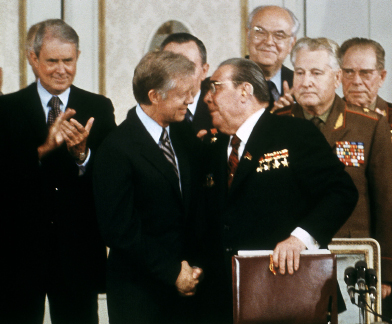
So, in the 1970s, world leaders agreed to reduce worldwide tensions. This period of relaxed tension is known as détente. In order to avoid future conflict, both superpowers agreed to sign treaties that would reduce the number of weapons each country possessed.
In the previous lesson, you saw there were five countries that possessed nuclear weapons in the 1970s. Many other small countries wanted to participate in the arms race and increase their influence in world decisions. It was believed that countries that had nuclear capability were a threat to other nations and were, therefore, more powerful. The superpowers realized that nuclear bombs were destructive and dangerous. Bombs were not an effective way to settle disputes.
| Treaty | Outcome |
|---|---|
| Test Ban Treaty (1963) | Countries were not allowed to test nuclear weapons in space. |
| Anti-Ballistic Missile Treaty (1972) | Defense systems against ballistic missiles were banned. The United States withdrew from this treaty in 2002. |
| SALT I (1972) | The full name of this treaty is the Strategic Arms Limitations Treaty. American President Richard Nixon and Soviet leader Leonid Brezhnev agreed to limit anti-ballistic missiles and freeze the number of nuclear bombs and long-range missiles produced. This would limit the number of weapons that would be built for the next five years. |
| Helsinki Agreement (1975) | The United States and the Soviet Union decided to accept European borders, and they also agreed to a Declaration of Human Rights. Each country agreed to guarantee freedom of speech, religion, movement, and self-determination. |
| SALT II (1979) | American President Jimmy Carter and Soviet leader Leonid Brezhnev agreed to limit the number of multiple-head missiles. The Soviet Union invaded Afghanistan during the talks, and Carter refused to continue negotiations. |
| START (1991) | The Strategic Arms Reduction Treaty limited the number of intermediate missiles both countries were allowed to possess. |
| Nuclear Non-Proliferation Treaty (1995) | Both superpowers agreed to limit the number of countries that would possess nuclear weapons. The treaty made it illegal to sell nuclear weapons or technology to countries that did not already possess these technologies and weapons. |
The world hoped these treaties would ease tensions and help all people feel more secure. This period of time has been described as a period of peaceful coexistence between the superpowers. Countries would possess fewer weapons and would not feel the need to increase their weapons stockpiles. As long as each superpower possessed the same type of weaponry as the other, world war could be avoided.
Even though arms treaties were signed, neither superpower was going to let the other superpower become strong enough to upset the balance of power. Both superpowers continued to develop new weapons.
In 1981, the Americans developed the neutron bomb, which could kill more people without causing as much damage to buildings. In 1983, the Americans began to develop the Star Wars defense system. Since both sides could destroy each other many times over with missiles, it seemed that intercepting these missiles was of primary importance.
A massive shield was to be built in outer space. In the 1980s, American President Ronald Reagan increased military spending to support this program. However, world events were changing and the need for such protection became unnecessary. The Star Wars defense system was never built.
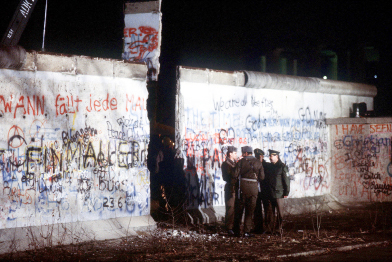
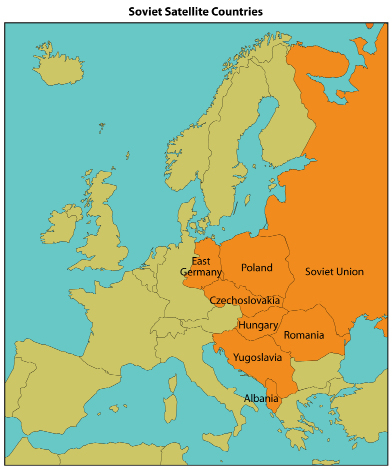
In 1985, many Eastern European countries began liberation movements that opposed communist rule. Countries such as Poland, Yugoslavia, and Czechoslovakia were the first to oppose communism and establish democratic governments. The Soviet Union’s empire was becoming smaller and smaller as countries declared independence.
In 1990, East Germany and West Germany were reunited. After more than 40 years, the Berlin Wall, a brick wall that had divided Germany into two independent countries, communist and democratic, was torn down.
The wall represented the clash of two opposing empires. It was built by the communist regime to keep East German people in and keep enemies of East Germany out. It became a symbol of the oppressive, totalitarian dictatorship in East Germany, the Soviet bloc, and the ideology of the communist world.
The tearing down of the wall was a dramatic sign that the Cold War was really over. German families who had not seen one another in decades were able to reunite. Communist Germany saw how industrialized and free West Germany was.
As East Germany and West Germany were reunited to, once again, form one Germany, a democratically elected German leader was chosen. The country worked hard to unite ideologies and economies.
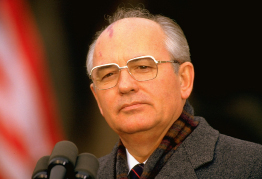
In 1985, Mikhail Gorbachev became the leader of the Soviet Union. Although he was communist, he had very liberal ideas. As communist countries were adopting more liberal forms of government around the Soviet Union, Gorbachev saw that the Soviet Union had no other option than to introduce modern liberal reforms.
Gorbachev’s political reform policies were called glasnost, which means openness. The Soviet government, which had forever made decisions based on the good of the country rather than on the good of its citizens, was now ready to become transparent, or open, with its citizens. Government decisions would be based on the will of the people. The people would be allowed to voice opinions without fear of punishment or imprisonment.
Many communist members of the Soviet Union opposed the change. If the Soviet Union became democratic, most communist government officials would lose their jobs. Many had been part of the government for decades and had no other skills. Regardless, Mikhail Gorbachev moved ahead with political reforms.
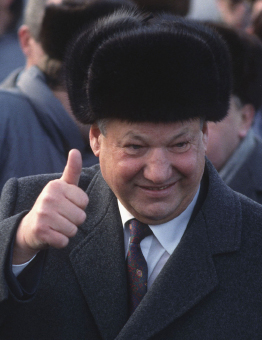
When the first free elections were held in 1991, Boris Yeltsin became the first elected president of the Soviet Union (President of the Russian Republic) and worked with other republics of the Soviet Union for each to declare independence.
Over 70 years of Soviet communist rule and 45 years of Soviet-American conflict had come to an end. All 15 republics of the Soviet Union were given the right to declare independence from the Soviet Union. Glasnost and other political reforms not only created political change, but the reforms changed the physical shape of the country itself. The Russian Federation, the largest of the former republics, took the Soviet Union's seat at the UN.
Gorbachev also introduced a liberal economic policy called perestroika, which allowed some free enterprise and individual economic choice in the Soviet Union. Perestroika moved the country away from central planning and closer to a market economy.
As Gorbachev liberalized the economy, demands for more change grew. Soviets demanded a greater variety of goods. However, economic change was not always good. The corruption that had come to exist within the Soviet government became more obvious with perestroika.
Jobs were no longer guaranteed under perestroika; unemployment and corruption grew. Many workers were unskilled and were not able to find jobs with good pay. Often, members of the old communist government used their connections and abused their power in order to open stores and control the market.
As Gorbachev was introducing political and economic freedoms to his country, other communist satellite countries demanded political freedom from the Soviet Union.
In 1980, Polish shipyard workers began a strike demanding better working conditions and an increase in salary. However, Poland was communist, and communists were not allowed to strike. The strikers joined together to establish the Solidarity Movement. The Polish government was not able to stop the Solidarity Movement, which proved to be anti-communist.
Eventually, Poland declared itself independent from communism and the Soviet Empire. The success of the Solidarity Movement and Poland’s break from Soviet domination and communism encouraged other countries to declare their independence. Soon, many countries in the communist bloc held democratic elections and declared themselves free from the Soviet Union.
For those who had suffered at the hands of communist dictatorships, the end of the Soviet era was a period of excitement and insecurity. For the communist countries that were ruled by dictators, the right to democratically elect their leader was a new challenge.
Political parties were embraced for their opposing opinions, and a new sense of political ownership was created. This political ownership also brought about fear. Under a communist regime, all citizens were guaranteed a job. The new regime meant the disintegration of communism. Jobs were no longer guaranteed, and many people were laid off. For the first time in a long time, unemployment became an issue.
Détente: a period of reduced tensions between the United States and the Soviet Union from 1971 to 1979
Glasnost: an official policy of the former Soviet Union that emphasized a more open government and wider distribution of information
Perestroika: a policy of the former Soviet Union that emphasized restructuring the economy
In this lesson, you explored the following question: How did liberal values spread at the end of the Cold War?
The spread of liberal values led to the collapse of the communist regime and the end of the Cold War. The end of the Cold War was an exciting time for people all around the world. The signing of arms treaties indicated to the world that the superpowers could no longer continue with the economic burden and the political tension caused by the Cold War.
The fall of the Berlin Wall and the collapse of communism brought peace and stability to Europe and the world. The possible extinction of the human race by nuclear attacks had become, people believed, a worry of the past.
Competition and open elections were allowed for the first time in Eastern European countries and in the Soviet Union. These new freedoms were mainly due to the collapse of the communist regime and the introduction of more liberal political and economic reforms, such as perestroika and glasnost. For now, there seemed to be stability in the world.
When Gorbachev introduced the policies of glasnost and perestroika, he hoped to move the Soviet Union toward a democratic and capitalist country slowly. Such great change required planning and organization. The people of the Soviet Union were not willing to wait.
Soviets wanted political and economic freedom immediately. They dreamed of freedom and prosperity. They wanted the freedoms they had heard existed in Western countries, such as the United States. MacDonald’s, Levi Strauss & Company, and PepsiCo were the first companies to enter the Soviet Union. Why were Soviet citizens willing to wait in line for hours and pay close to a full day’s salary to eat a meal at MacDonald’s? What would these three companies represent to the Soviets?