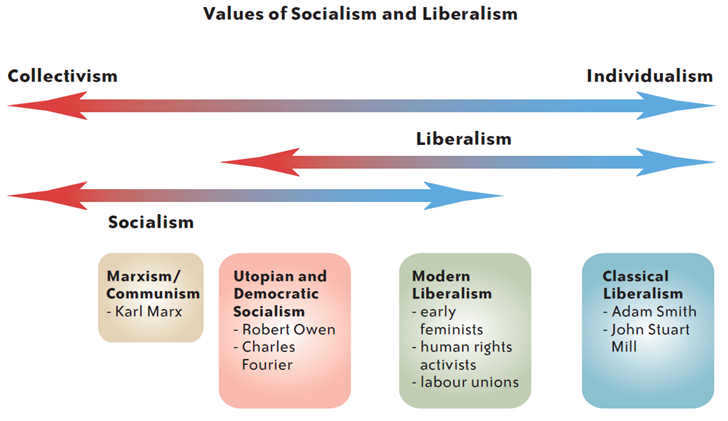
As we have discussed, the opposition to capitalist ideas and the resulting inequality resulted in a shift toward the left, toward more government involvement, and in some cases, total government involvement and extreme forms of communism. The move toward communism started with the Russian Revolution and spread from there.
The idea of ‘sharing’ resources and collectivizing property, land, and business, especially during the Roaring 20’s full of free-market consumerism and endless choice and self-interest was a very scary proposition for Americans.
This conflict of ideologies, left vs right, along with the legacies of WWII provided for an ideological conflict that lasted until the 1990s (and some argue still continues today) that involved most of the world.
In 1945, one major war ended and another began. The Cold War lasted about 45 years. There were no direct military campaigns between the two main antagonists, the United States and the Soviet Union, yet billions of dollars and millions of lives were lost in the fight.
The United States became the leader of the free-market capitalist world. America and its allies struggled to keep the communist, totalitarian Soviet Union from expanding into Europe, Asia, and Africa.
For a long period of time, between 1945 and 1991, citizens of the world feared nuclear attacks from any one of the many countries that possessed a nuclear bomb. Ideological differences, including the struggle between communism and capitalism, created insecurities in most countries of the world. No country knew whether or not a nuclear bomb would be sent its way. What conflict could be so great that countries were willing to stockpile arms and threaten to use them against other countries?
The period from 1945 to 1991 is referred to as the Cold War. During the Cold War, countries threatened to use their weapons on other countries because of ideological differences. When the Cold War ended with the collapse of communism, many thought that peace would replace insecurity and fear. Those people were wrong.
Terrorism became the new threat. Terrorist groups are not bound by county lines. Rather, terrorist groups are bound by strong beliefs and ideologies based on religion, ethnicity, politics, nationalism, and so on.
Fear of the ideological differences between entire countries was replaced by fear of international terrorism. Neither the Cold War nor international terrorism are traditional wars. However, like traditional wars, both are a result of ideological conflicts, and both are devastating.
In this unit, students will :
To cover the outcomes, there will be 5 main lessons.
| Lesson | Description |
|---|---|
| 1 | Competing Ideologies Create Tensions in International Relations |
| 2 | Competing Ideologies can Escalate and Reduce Tensions |
| 3 | Liberal Values Spread at the End of the Cold War |
| 4 | Learning from the Past |
| 5 | Liberalism's Reach and 911 |
Graded work includes three discussions, a unit quiz, and an assignment. Graded work will appear on its own content page so you can clearly identify what to turn in and where. Due dates can be found in the course Checklist. If ever you cannot meet a course due date, let your teacher know through private discussions.
The vocabulary below will used and covered in this unit.