In this section, you will develop your understanding of ideology by:
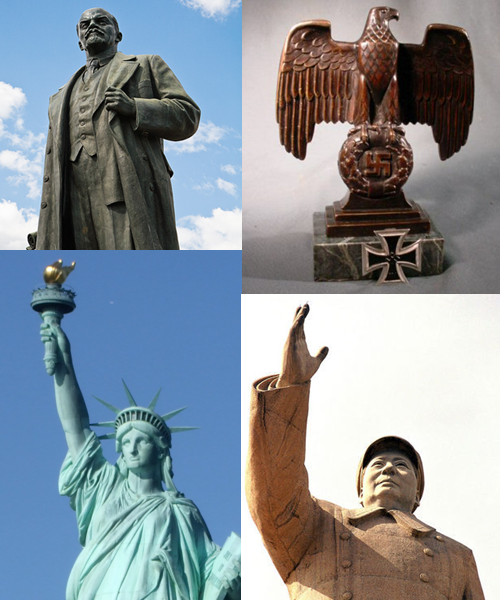
Look at the statues to the right. When you look at them, do you simply see pieces of bronze and marble, concrete and copper, or do you see a representation of an idea or a set of ideas?
For many people in the world, the images above are each associated with a set of ideas for organizing human society. In other words, they each are associated with an ideology. Can you identify any of the ideologies represented by the statues? If you can, that’s great. If you can’t, don’t worry. You’ll become familiar with them as you work your way through the course
In the preceding section of this course, you learned a definition for the term ideology and you began to develop an understanding of what an ideology is. In this lesson, you will deepen and expand your that understanding.
As noted previously, an ideology can be defined as a set of beliefs or values, in particular those which form the basic components of a political or economic theory or system. While this is a reasonable definition, it is not the only definition of the term. Your goal as you work through this lesson should be to be able to formulate your definition of ideology based on the understanding you develop as you work through the activities.
While the beliefs and values that underlie ideologies may be very different, ideologies themselves tend to share certain common characteristics. Recognizing the characteristics of an ideology is important to gain a clear understanding of what an ideology is.
All ideologies contain a set of beliefs and values bout similar things. They are all concerned with the essential questionsof life, such as:
| Characteristics of an Ideology | |
|---|---|
| Beliefs about Humans |
|
| Beliefs about Society |
|
| Interpretation of History |
|
| Thoughts/Vision for the Future |
|
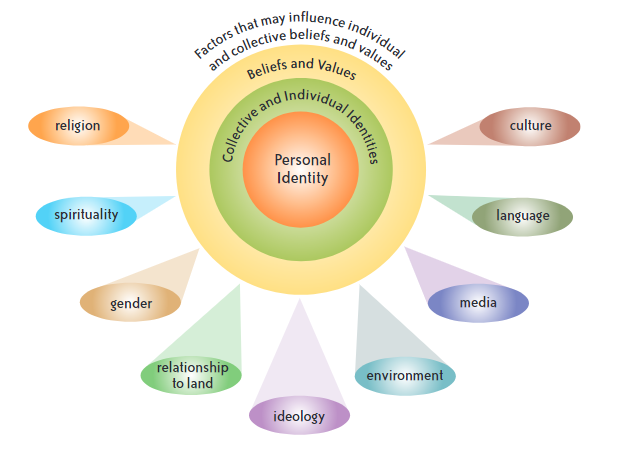
If you were going to design a set of beliefs and values to guide people in their interactions with others, what aspects of human society would you focus on? Throughout history, there have been some themes that have recurred in ideologies. These themes include nation, class, race, relationship to the land or environment, gender, and religion. Depending on the ideology, a particular theme or themes may be dominant. For example, adherence to a religious belief may be more important than loyalty to a nation.
| Theme | Description | Example |
|---|---|---|
| Nation |
|
|
| Class |
|
|
| Race |
|
|
| Environment and Relationship to Land |
|
|
| Gender |
|
|
| Religion |
|
|
The nature of society refers to the collective organization of individuals who share common goals, values, and norms, and who interact with one another within a particular social structure. Society provides a framework for human interaction, cooperation, and the establishment of social order. It encompasses various institutions, such as family, education, government, economy, and religion, which shape the functioning and dynamics of social groups.
As individuals, our roles within society are multifaceted and can vary depending on cultural, social, and personal factors. Here are some key aspects of our roles within society:
It's important to recognize that societies are diverse, and the specific nature of society and individual roles can vary across different cultures, historical periods, and social contexts. Additionally, societal norms and expectations can evolve as societies undergo social, economic, and technological changes.
Understanding our role as individuals in society involves recognizing our interconnectedness, embracing our rights and responsibilities, and actively participating in shaping the social dynamics and progress of our communities. By respecting the rights and dignity of others, promoting social harmony, and contributing to the betterment of society, we can collectively strive for a more just, inclusive, and flourishing social order.
Do you feel uncomfortable with change or do you embrace it? Do you wish things could always stay the same? Do you wish you could change things back to the way they were?
Ideologies are often categorized based on their approach to change. When referring to ideologies the terms frequently used to describe attitudes toward change are left wing and right wing.
The use of the terms left and right to describe attitudes toward change finds its origins in the French Revolution, specifically from the seating arrangements in the French National Assembly. In the National Assembly, those people who wished France to remain a monarchy and wanted the king to still hold considerable power sat together on the right side of the chamber or the “right-wing”. They were averse to change, hence the term "conservative" also being associated with the "right wing". Those who wished to see the king's role in government completely abolished sat on the left wing. Those who saw a very diminished role for the king in government, a position midway between the other two groups, sat together in the middle ("centrists"). The legislators had grouped themselves based on how much change they wanted in government. It made vote counting easier for the Speaker.
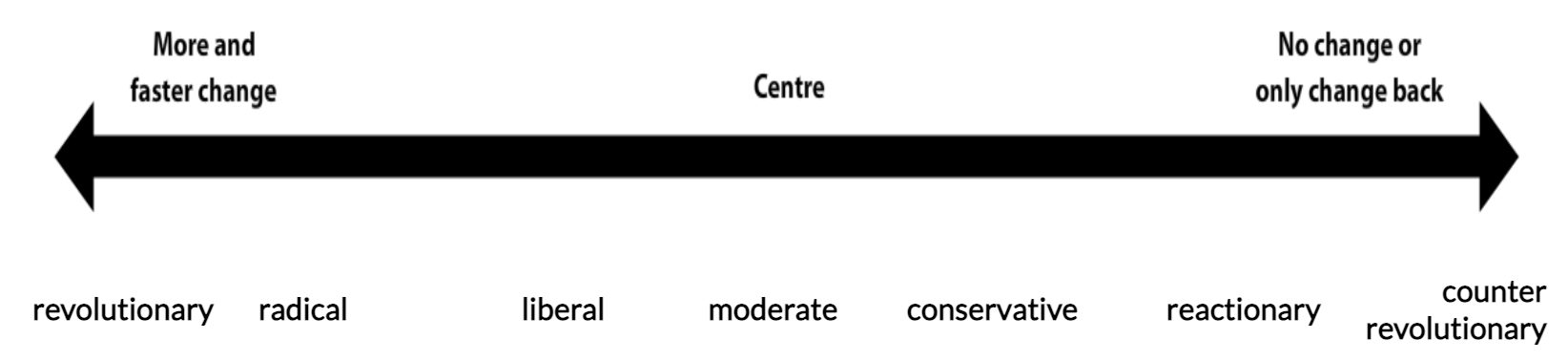
Today, a person or ideology which advocates rapid change is called a revolutionary or radical. Radicals can sometimes be extremists who may be willing to use violence to obtain their goals. Revolutionaries want to overthrow the existing system with a new system.
Extremists of another kind are those who strongly resist change, often violently. People or ideologies which strongly, sometimes violently, resist change are termed counterrevolutionaries or reactionaries. They often want society to go back to some past ideology or "golden age".
In the middle are people and ideologies that are characterized as moderate. Moderates who support gradual change are typically characterized as liberal. Moderates who express some resistance to change are often labeled conservative. Whatever their attitude toward change, moderates are distinguished from extremists by their unwillingness to use violence to achieve their goals.
You will often hear/see references to the ideological, political, or economic spectrum in this course and the media. The video below explains the political spectrum beyond the basics of preference for "change" outlined in the original left/right spectrum outlined above. Applying an X/Y graph to the spectrum allows for more complexity in ideologies.
Conservative: a person or ideology that is opposed to, or cautious about, change.
Counterrevolutionary: a person or ideology that vehemently resists change or seeks change back to a previous state of affairs. Counterrevolutionaries may advocate violence to achieve their goals.
Extremist: a person who has fanatical or immoderate views and beliefs
Left-wing: a term applied to ideologies, governments, political parties, and policies that promote change.
Liberal: a person who believes in the ideology of liberalism. Not to be confused with the Liberal Party or a member of the Liberal Party. This would be a large "L" Liberal - a member or supporter of the Liberal Party. Conservative Party members are also small "l" liberals because they believe in a liberal ideology; not the same liberal ideologies as the Liberal Party, or the NDP. (Note: US sources often misuse the term "liberal" when they really mean socialist)
Moderate: a person or ideology that shuns extremism and rejects violence as a means to achieving political or social goals.
Radical: a person or ideology that advocates rapid and substantial change. Often rejects political and economic traditions of the past.
Reactionary: a person or ideology that vehemently resists change or seeks change back to a previous state of affairs.
Revolutionary: a person or ideology that advocates rapid and substantial change and the replacement of the existing system, often through violent means.
Right-wing: a term applied to ideologies, governments, political parties, and policies that resist change or promotes change that will return society to a previous state or condition.
In this lesson, you moved beyond a simple dictionary definition of ideology and developed a deeper understanding of what an ideology is. You should now be aware that ideologies share certain common characteristics including, rituals, “sacred” documents and heroes, a simplified picture of the world, a belief about the nature of human beings, a plan for the structure of society, and a vision of the future. You should be able to recall these characteristics and explain them.
You have also learned that certain themes of nation, class, race, environment, gender, and religion tend to underlie ideologies. You should be able to recall these themes and explain why in some ideologies, certain themes may be deemed more important than others.
Finally, you have learned that ideologies can be characterized and labeled based on how they approach change. At this point, you should be able to confidently explain the difference between a moderate and an extremist. You have been introduced to the terms revolutionary, radical, liberal, conservative, counterrevolutionary, and reactionary. You should be able to provide a good explanation of what each of these terms mean and you should be able to start applying them to ideologies, values, and beliefs with some confidence. You will continue to develop your understanding of these labels as you progress through the course.
For the quotes below,
Quotes:
You may want to access the following additional resources.