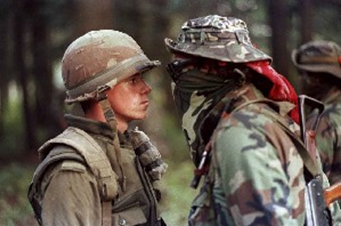
Strictly defined, liberal democracy is the rule of the majority with consideration for minority rights. This does not mean that the needs of all citizens are always served or guarantee that the representatives chosen to represent you will share the same values and beliefs that you hold. Though the basic concept of individual rights is generally accepted by citizens in Canada and prescribed in the Charter of Rights and Freedoms, the nature of the individual rights to be protected and the degree of protection they should receive is often open to interpretation and debate.
Consequently, an ideology may sometimes be imposed on minority groups who may not share the beliefs or values of the majority. Some people may characterize such impositions of ideology as illiberal. In this lesson, you will examine the extent to which liberal principles have been imposed on the First Nations, Metis, and Inuit peoples in Canada.
In this lesson, you will explore this question: To what extent should liberal principles be imposed on people in your country who may not share them?
Individuals all have a certain way of looking at the world. This is sometimes referred to as their paradigm. People are taught and absorb their individual paradigms through their cultures and way of life. A person’s paradigm is constantly shifting as priorities change. As an example of this, reflect on the following questions:
Since many Western liberal democracies such as Canada and the United States were most recently settled by Europeans, these nations have adopted Eurocentric governance and society models. These governmental structures embraced by European settlers used classical liberal principles such as the importance of the individual as the basis for the creation of laws and society.
But this model did not always represent the ideological perspectives of all of Canada’s citizens. To a large extent, the voices of Canada’s First Peoples (First Nations, Metis, and Inuit) were ignored when governmental structures and mechanisms were established.
Consider the following questions:
Some aspects of Indigenous ways of thinking present an interesting challenge to liberalism. One of these principles is the importance of the collective. The collective in an indigenous may have more influence on the choices of individuals with respect to, for example, natural resource development or economic development.
In addition, the many traditions of Indigenous peoples seem to provide a different interpretation of progress than that of liberalism. More emphasis is placed on a connection to the past. Tradition and continuity are essential, which is evident from the position of importance that elders have in society; being valued for their wisdom, knowledge, and experience.
In many Indigenous societies, group needs are more important than individual needs.
The use of sentencing circles in conjunction with Western legal structures is often used. A sentencing circle is used to determine the sentence for an offender who has been found guilty of a crime by the justice system. The circle includes the judge from the criminal trial, the offender, the victim, and members of the community, including elders. The group arrives at a sentence by consensus.
The sentencing circle was introduced in part because of a perceived bias in the Canadian justice system against Indigenous people.
This idea is being adapted for some non-indigenous contexts as well, such as youth courts.
One of the ways cultural and ideological differences were most obvious was in the concept of landholding. While people can control and exercise stewardship over a territory, ultimately the land belongs to the Creator - who gives the land to the people to care for in perpetuity - and the right to inhabit and live from that land is thus inalienable.
As more immigrants arrived from Europe, more land was needed to accommodate them. By 1812, European settlers outnumbered Indigenous by a ratio of 10 to 1 in eastern Canada. Treaties were negotiated that allowed newcomers to claim the land First Nations inhabited in exchange for promises of compensation in the form of annual payments, social and economic benefits, and the continued use of some land and resources. Many First Nations leaders wanted peace and harmony with the European settlers who were pressing in upon them, but above all, they wanted to protect and preserve their way of life.
By the time of confederation in 1867m 123 treaties and land surrenders had already been negotiated in British North America. By 1975 and the James Bay Agreement, there were 500. Conflicts resulted from some of these agreements. Such as:
Though aboriginal ideology and the liberal principles adopted by the Canadian government often conflicted, the government attempted to impose a Eurocentric model of liberalism on aboriginal peoples through policies such as the Indian Act, Enfranchisement, Residential Schools, and the White Paper. All of these policies were aimed at assimilating First Peoples in Canada and left a legacy of cultural destruction from which many Indigenous societies are still recovering, as evidenced in the Truth and Reconciliation Commission Report.
The Gradual Civilization Act of 1857 offered that any man willing to give up his Indian Status would be given 50 acres of land for his exclusive use. He would also receive a portion of the treaty settlements and other band money. When he died, his children would receive the land, and essentially the reserve land would be removed from the band's claim.
The Indian Act was legislation that created sharp distinctions between Indigenous and Métis people. Métis people were not recognized under this legislation until January 8th, 2013. The Indian Act was legislation that allowed for the administration of almost every aspect of an Indian person's life.
Throughout its history, the Indian Act had three main principles:
Christianity was imposed on Indian people as a means of "civilizing" them. Potlatches and Sun Dances were outlawed in 1884. Persons who were caught celebrating these events could be imprisoned. Banning these traditional gatherings assisted missionaries in their attempts to replace Indian spiritual beliefs with Christian beliefs.
"No Trespassing" signs were posted on the boundaries of Reserves.
Enfranchisement (getting the right to vote) for the purposes of assimilation was a constant feature of the Indian Act. If an Indian person became enfranchised (accepted the right to vote) he or she had to relinquish their Indian Status.
To this day, the provisions of the Indian Act allow for the administration of Indians on Reserves in areas such as education, taxation, management of land, and membership.
In 1960, the Federal Elections Act was amended to allow Indian people to vote. An Indian person could now be both an Indian and a Canadian citizen at the same time.
Reserve clusters were kept far enough apart to discourage Bands from forming alliances against the government.
Indian Agents and Farm Instructors were sent to the Reserves. Life on the Reserves centered around them -- they lived on the Reserves and made all decisions:
In 1996, after five years of inquiries and public hearings, the Royal Commission issued a report recommending the creation of:
However, many people are critical of what they perceive as a lack of government action to address the above recommendations.
Before you move ahead, reflect on what you have learned in earlier modules about classical and modern liberalism. Consider the following questions:
Enfranchisement: granting people the rights of citizens, especially the right to vote
Eurocentric: an ideal emphasizing the values and perspective of European tradition and institutions, often to the detriment of other people’s values
Indian Act: an act of the Canadian Parliament passed in 1867, which dealt with the rights of First Nations people who signed treaties or became registered citizens under the act
Paradigm: a set of assumptions, concepts, or values which shape the way an individual views the world
Residential Schools: a school system created under the Indian Act which attempted to assimilate Aboriginal people
White Paper: an official government document released in 1969, which attempted to further assimilate First Nations, Metis, and Inuit peoples of Canada
In this lesson, you explored the concept that not every group within a democratic nation may embrace the Western liberal traditions on which liberal democracy is founded. You did this by examining various Aboriginal perspectives on society and then analyzing how compatible Aboriginal ideals like consensus government are with the principles of modern liberal democracy in Canada.
You have also learned that the differing ideological perspectives held by the Canadian government and the First Peoples of Canada have often led to conflict. You have researched an event that illustrates such a conflict and examined how the opposing groups went about trying to achieve their respective goals.
Based on the knowledge you have gained in this lesson, you should be able to articulate your own response to the inquiry question for the lesson: To what extent should liberal principles be imposed on those people who may not share them?
You may want to access the following additional resources.