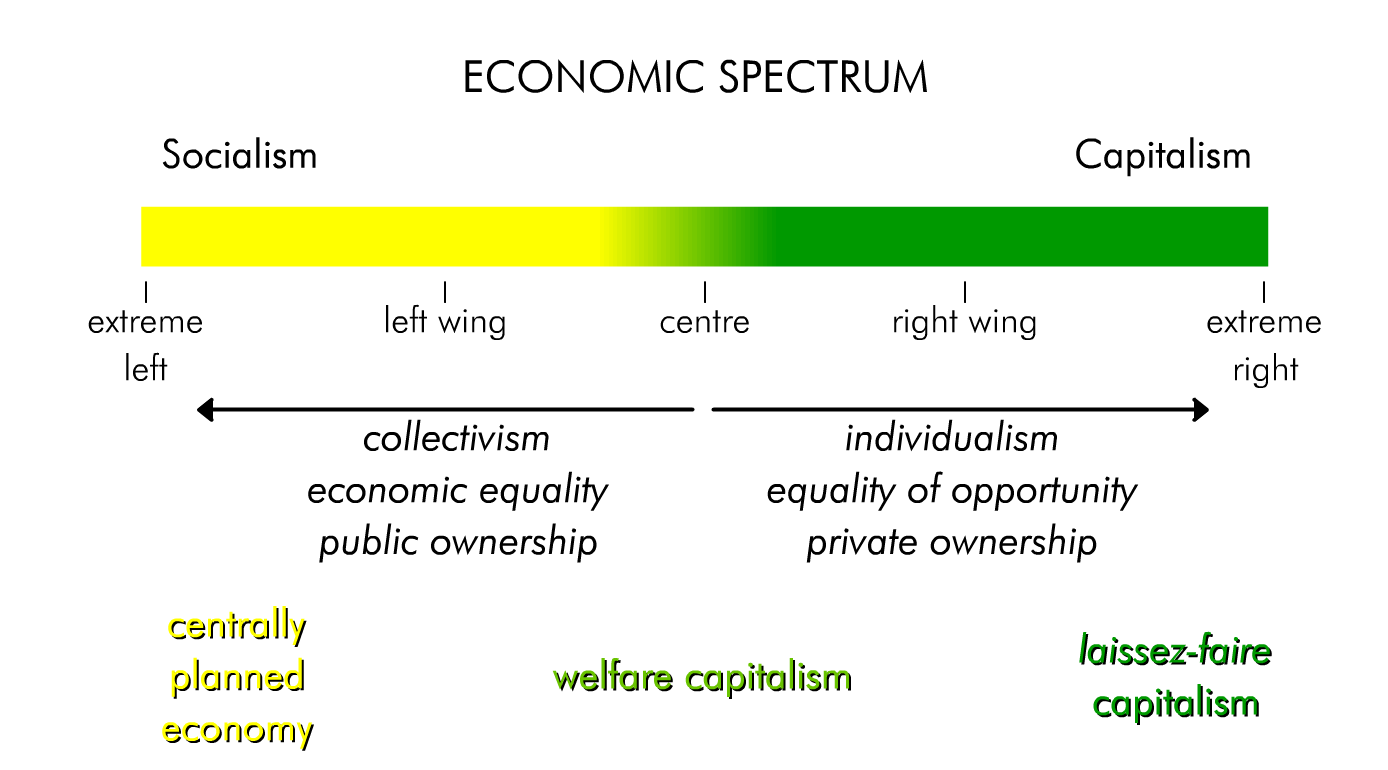
Every day you make dozens of decisions. You might decide whether to work, study, or go to the mall. You might decide whether to buy a Starbucks or save your money. These decisions all have something in common—they are all economic decisions.
All individuals and groups in every society face similar economic decisions because it seems there is just never enough money to go around. The structure societies set up to deal with the production, distribution, and consumption of goods or services is called an economic system. Just like political systems, there are many kinds of economic systems.
Economic systems are also based on the ideologies of collectivism and individualism.
Some economic systems follow an ideology based on the needs of all individuals in society. Other economic systems follow an ideology in which individuals are responsible for their own needs.
What do you think? Should individuals be fully responsible for their economic well-being?
All societies must answer three economic questions. The way that they answer those questions determines the type of economic system they use. The options are pretty limited - either it is a left, a right, or a centre perspective on it.
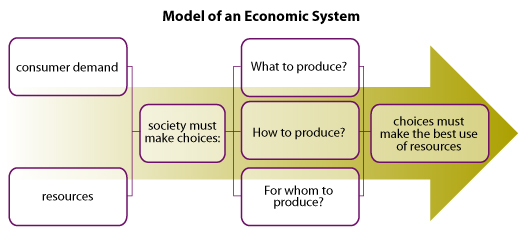
What is the best, most efficient way for a nation to use its resources and provide for its people? In traditional, agricultural societies, the answer to this question is relatively straightforward. Since the Industrial Revolution, however, increasingly large and complex economies have struggled to find solutions to deal with the wealth, poverty, and diversity created as a result of industrialization. Each new generation of citizens and leaders has continued to find both new answers and new problems, as economic ideas and systems continue to evolve.
An economy may be defined as the set of processes, rules, and procedures that groups of people in a nation use to meet their wants and needs. The basic problem in every economy is scarcity; there are never enough resources to fulfill these wants and needs
An economic system is based on the production and consumption of goods and services. Countries choose the economic system they will follow based on the role the government plays in the economy of the country.
How a government responds to the three questions above is determined by the type of economy the country has adopted. For example, liberal governments allow entrepreneurs the opportunity to risk their money and either make a profit or experience a loss. The profits or losses are determined by the supply and demand of a product.
Just like with politics, there is an economic spectrum on which different types of economic systems can be placed. Where society falls on the economic spectrum is tied to where society falls on the political spectrum and systems are often portrayed as left or right depending on how much involvement the government has.
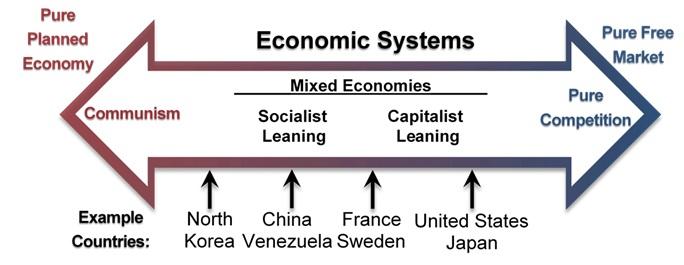
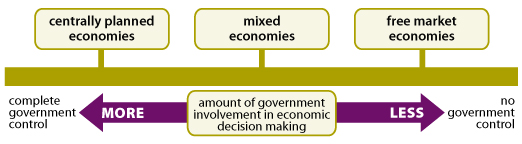
Over the years, society has developed several different economic systems to deal with the problem of scarcity and to meet the needs and wants of the people. All economic systems experience differing levels of government intervention, which is why the arrow on the economic spectrum points in both directions.
Economically speaking, the left side of the spectrum supports government control of the economy. The government controls the economy by owning and distributing property equally based on what is best for society.
The right side of the spectrum is termed as right because property is owned by individuals and economic activity is the result of competition in the marketplace.
The spectrum shows there are two pure economic ideologies or models: communism (extreme collectivism) and capitalism (extreme individualism).
Communism is based on an ideology of collectivism. Collectivists believe society must care for the needs of the entire population and thus control and plan the economy rather than leave it to external factors.
Pure free-market capitalism is based on the beliefs and values of individualism. Individualists believe the individual must satisfy her or his own needs and should not rely on society for help and thus has a hands-off approach to the economy.
Today there are almost no economies that identify with pure collectivism (Communism) or pure individualism (Pure Free Market). Modern economies around the world fit somewhere in between.
Found in the middle of the spectrum are free markets and mixed economies. Liberal economic systems take certain elements of collectivism and individualism and merge them into one system. Economic systems that have adopted a liberal ideology are known as free market economies and mixed economies.
Mixed economies include government involvement in economic decision-making, yet they still maintain a citizen’s freedom. The government involves itself in areas like health care and education because those areas affect a wide spectrum of the population. They are also areas in which private industry could create disparity based on what people can afford. Mixed economies embrace the liberal ideals of allowing for individualism where appropriate, such as what goods are offered for sale in stores or what type of businesses an individual may open. Canada is an example of a mixed economy with strong liberal ideologies at its base.
Capitalism: extreme individualism
Collectivists: believe society must care for the needs of the entire population and thus control and plan the economy rather than leave it to external factors.
Communism: extreme collectivism
Rree markets: voluntary exchange and the laws of supply and demand provide the sole basis for the economic system, without government intervention
Individualists: believe the individual must satisfy her or his own needs and should not rely on society for help and thus has a hands-off approach to the economy.
Mixed economies: include government involvement in economic decision-making, yet they still maintain a citizen’s freedom
Economic systems, like political systems, are based on the ideologies of collectivism and individualism. Liberal economies tend to place more emphasis on economic freedom (individualism). However, many liberal economies also work to balance economic freedom with protecting the collective. Canada’s mixed economy is a good example of this.
Today, countries of the world seem to be moving more and more toward an economic balance. It is up to the leaders and citizens of a country to adopt economic policies that best reflect the will of the people - as stated in the quote from John F. Kennedy, former American president.
You may want to access the following additional resources.