It is generally accepted that John Stuart Mill’s essay On Liberty is one of the most important contributions to the origins of liberal thought. On Liberty was published in 1859, during the time of the Industrial Revolution. In it, Mill attempts to prove the benefits of allowing as many individual rights as possible by limiting the role of the government. Mill believed, as other classical liberals did, that the role of government was to do only three things: preserve the rule of law, protect private property, and ensure the security of the individual.
Classical liberals such as Mill could not justify laws that restricted individual choice and freedom because of what might be. These kinds of laws try to prevent action before it happens. They are based on the assumption that something bad will happen. But what if nothing bad happens? Mill did not believe that the possibility of something bad happening was reason enough to restrict individual rights. He believed that although a government can try to persuade citizens to follow a certain path, it cannot force them to do so by law. According to Mill, the individual must have the ability to make his or her own choice. This idea of individual freedom and choice is essential to liberalism.
Mill worked closely with his wife, Harriet Taylor Mill who wrote On Liberty with him and another crucial essay, On the Enfranchisement of Women. He also wrote with his step-daughter, Helen Mill, after Harriet's death.
In keeping with his respect for individual rights, Mill warned governments and societies in general of the danger of promoting the mass mind, or one acceptable way of thinking, and instead advocated for the freedom of speech. The mass mind is intolerant to individual voices that may disagree with the established ideas of the time.
"If all mankind minus one were of one opinion, mankind would be no more justified in silencing that one person than he, if he had the power, would be justified in silencing mankind. " - John Stuart Mill, On Liberty
Mill believed that it was more dangerous to society to silence the individual from speaking than it was to allow him or her to express a controversial or perhaps offensive opinion. This is because that one dissenting voice or controversial opinion could be necessary for proving or disproving established beliefs. In that way, the dissenting or opposing voice could be the key to changing society for the better.
The Harm Principle is another important idea for Mill. In writing about this, Mill stated that it was appropriate for individuals to take whatever actions they wanted so long as those actions did not harm another individual. It would be possible for anyone to have the right to say or act in ways that were quite shocking so long as no one was injured through those words or deeds.
"The only purpose for which power can be rightfully exercised over any member of a civilized community, against his will, is to prevent harm to others." - John Stuart Mill
Mill firmly believed in the freedom of speech for all, including women. He believed that a government silencing a voice was more dangerous to society than hearing offensive or untrue speech. From your point of view, is there any type of speech that need not be voiced? Is there any type of expression in which you would support a government ban?
Throughout your life, you will likely encounter some ideas that are not in keeping with your way of thinking. Sometimes you may find yourself in a debate or argument with someone who has ideas that are not only contrary to yours but also offensive to you. How would you handle such a situation? How would you expect a government to handle an idea or set of ideas that are contrary to its ideological principles?
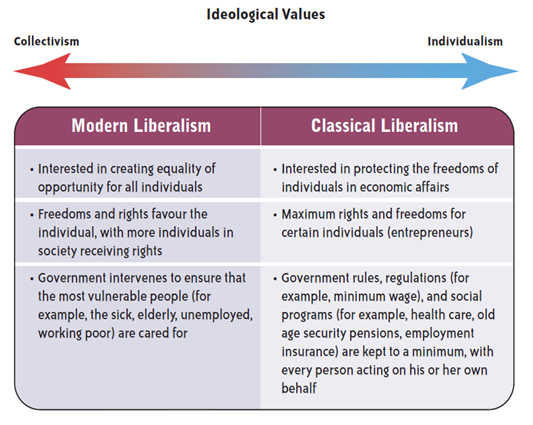
While classical liberalism was concerned with granting economic freedoms to business owners in a market system, modern liberalism developed over time to address concerns with the inequality created by a laissez-faire capitalist society. Although people were free to participate in the economy, many still lived in poverty.
Some began to ask such questions as:
By the turn of the 20th century, some people began proposing changes to the laws to ensure that all people had the same rights and freedoms, for example, by giving all adult citizens the right to vote. Some also felt that the government had a responsibility to ensure that all people have the same opportunities, regardless of their skin colour, gender, or economic background.
Utilitarianism: The idea that the “right” choice is the one that results in the greatest good for the greatest number of people
Harm Principle: a belief that the only time you should restrict someone’s rights is if they are going to harm somebody else
Suffrage: The right to freely vote in an election
Tyranny of the Majority: The idea that individual voices may be silenced because the majority of people disagree with those voices.
John Stuart Mill was a prominent supporter of:
Mill wanted a society with as many individual rights as possible with as little government as possible. However, society was changing to question if this would be possible without laws that regulated the fair treatment of workers at least to some extent. This was the start of the change from classical to modern liberalism.
Mill did not believe that laws should restrict your freedoms based on the possibility that something bad could happen. Some of the laws in Alberta today limit your freedoms to protect your safety.
Laws such as wearing bike helmets, using a seat belt, not using your phone/device while driving, etc.
You may want to access the following additional resources.