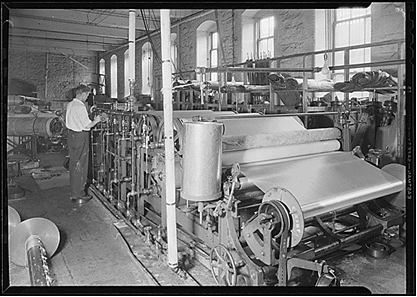
Imagine you are married and have a family to support. You arrive at work one day and your employer asks you to make adjustments to a large machine while it is running. You immediately recognize that to do so would jeopardize your safety. You could lose a limb or even your life. You suggest to your employer that the machine be turned off before the adjustments are made, but he insists that doing so will significantly slow down production. You express your concerns about your safety.
“I’m free to run my factory how I like....” he responds, “...and you’re free to quit and find a ‘safer’ job if you want.” I have people lining up outside to try and get work here. I’m sure one of them won’t mind crawling in there to make the necessary adjustments.”
You realize he is right. He does have the right to run his factory how he likes. And you are free to go find safer work. But both you and he know there are few jobs to be had in town. You see unemployed people lined up outside the factory every day as you walk through the gates. How much freedom do you and other workers really have, you wonder, other than the freedom to go hungry if you won’t do exactly what your boss wants?
Adam Smith’s approach to liberal economics took hold at the cusp of a historical period called the Industrial Revolution. Technological innovations combined with tremendous economic freedom allowed countries like Great Britain and the United States to become economic superpowers. Many business owners became wealthy beyond imagination. But for many who toiled away in the factories of Britain and the U.S., the benefit of the free market was harder to realize.
To understand the difference between classical liberalism and modern liberalism, you’ll need to be familiar with some of the effects of the unbridled capitalism that was spawned by the classical liberal ideas of Smith, Locke, and others.
Classical liberalism is a political and economic term that describes a period of time that began at the end of the eighteenth century.
The primary characteristic of classical economic liberalism was that the government did little to interfere in economic decisions.
If you had lived during the period of classical liberalism, you would have had total freedom to choose how to live. You would have worked your hardest to succeed and live the best life you could. Classical liberals argued that if all people worked hard and were free to pursue their goals, everyone would prosper and society would do well.
In this lesson, you will explore the question: What were the impacts of classical liberalism?
Before 1750, life was not easy in the small towns and on the farms in rural England. People had to work hard, and the primitive methods of farming produced very little food.
People tended to only be able to produce enough food for their survival. They did not produce any extra food they could sell for profit. Without profits, they were not able to buy non-essential items. The laws that were in place allowed very limited personal freedoms.
Before the Industrial Revolution, work was done in the homes. This was called the domestic system. An example of the domestic system was when women would weave cloth on small looms, and businessmen would go to each home to collect the cloth. Women were paid a small salary for their work.
The domestic system proved to be highly inefficient. The time spent traveling from one house to another, the inconsistent quality of craftsmanship from the weavers, and the lack of control.
When the domestic system proved to be inefficient, factories were opened. Without the extra income from domestic work, many farmers who owned small parcels of land were no longer able to support their farms. They were forced to move to the city, where they worked in factories and helped create what became known as the Industrial Revolution.
Industrialization led to an increase in investments and salaries for those capitalists willing to risk their money in business. New businesses meant new products, new jobs, and growth in new businesses.
In accordance with classical liberal ideology, there was little to no government involvement in the economy at this time. Government involvement would only interfere with the natural law of competition.
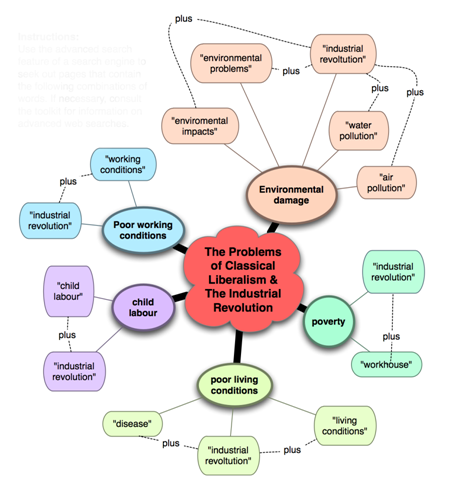
Business owners were not required to consider the welfare or lifestyle of workers. Workers were simply resources, like cotton or dye, to be used to create goods. They worked long hours in harsh conditions and made little money. As a result, workers were prone to life-threatening illnesses.
During the Industrial Revolution, business owners made large fortunes. However, for the majority of the workers, life was difficult if not unbearable.
Efforts by entrepreneurs to reduce the costs of production led to the use of labour-saving machinery. The use of machines led to widespread unemployment, low wages, and terrible working and living conditions.
Each time a new machine was invented to make a product, the price of the product to consumers went down. Machines were cheaper and more efficient than people. When machines replaced people, the unemployment rate rose and wages went down.
In many cases, because children were small and could fit between machines better than adults, they were preferred to adults. As a result, children were expected to put in long hours at the factories, working alongside their parents. Because they were smaller and not valued as a full worker, children were often paid a fraction of what an adult made. The machines did not improve the working and living conditions of the working family. In many ways, machines made life worse during this time.
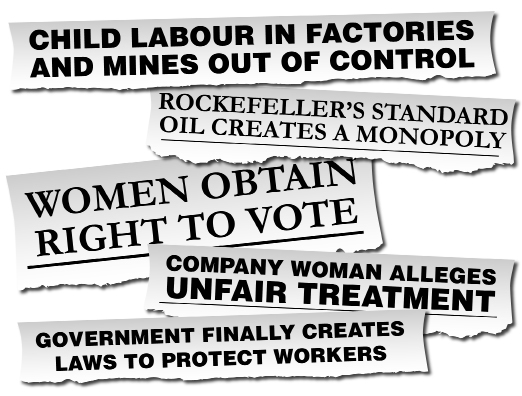
Take a look at the newspaper headlines at the top of this section. They sound like issues that were dealt with long ago. While these situations might be concerns of the past, they were real and important issues at the time. Working conditions were terrible, and salaries were small.
Prior to the 18th century, agriculture retained many of its medieval aspects. Farming was done on small plots of land that were held in common. Over time, these common lands became enclosed and private property of an individual and the small farmers lost access to the land. Inventions and growth in sheep farming required the land to be worked by those experienced in using the machinery.
Farmers received little compensation for their small bits of land, and fewer labourers were needed, forcing farmers off the land and into the factories.
Europe's exploration overseas in the 15th and 16th centuries brought an influx of gold and silver from America's economy. Financial institutions were introduced to Britain leaving the government-regulated mercantilist system in ruin.
Free trade and capital (money) for factories made new technologies desirable and allowed machinery to replace hand labour. Commercial entrepreneurs emerged along with trading merchants.
Factories expanded and a wealthier population wanted more and better goods, as well as inventions capable of large-scale production. The textile industry started the boom followed closely by other manufacturing industries.
Classical liberalism was embedded into this development in agriculture and commerce and provided an introduction to the capitalist society.
Many would argue that, despite the negative impacts associated with classical liberal economics, Adam Smith was ultimately proven correct. In Britain, where the Industrial Revolution got its start, the economic freedom afforded entrepreneurs owners, and other businesses had clearly benefited the nation as a whole. By the dawn of the 20th century, Britain was one of the wealthiest nations in the world, an economic and military superpower. The standard of living of its citizenry had improved significantly over the previous 150 years.
The class structure started to change. Those whose wealth was gained from land ownership and the aristocratic class were threatened and overpowered by those who owned factories, bankers, retailers, lawyers, engineers, etc. (known as nouveau riche).
While the nouveau riche enjoyed economic gains, the labourers endured horrible working conditions and were underpaid, barely able to meet their basic needs. As more people migrated to the cities in this time of great urbanization, overcrowding and unsanitary living conditions became the norm. Tenants were often exploited by landlords looking to take advantage of those in need.
Domestic system: work done in/at home
Industrialization: the stage of economic development during which the application of technology results in mass production and mass consumption within a country.
Nouveau riche: newly wealthy
Urbanization: an increase in the number of people residing in cities and an extension of urban boundaries to include areas that were previously rural.
The implementation of classical liberal philosophy during the 18th and 19th centuries in Europe and America had a profound effect on the world. The ideas put forth by Adam Smith, John Locke, and others provided support for unrestricted capitalism and the Industrial Revolution. The free market system of the period fostered technological change and generated great wealth and political power for industrialists and their nations, but it was often at a high cost for workers and the environment. Many would come to see that inequities in wealth and political power created by the adoption of classical liberal ideals would have to be addressed.
Watch this video on the works of the author Charles Dickens. Reflect: How do authors bring attention to some of the most difficult issues and major changes in society that people might not be aware of?