In the year 2008, the world experienced another recession. Unemployment soared, and the stock market crashed. Imagine it’s 2008. Monique has just lost her job as an architect. She enjoyed her work and she cannot find another job. She owns a large house and has to make big mortgage payments. She just bought an expensive car, and her car payments, which she could afford while working as an architect, are now too high.
Monique is collecting employment insurance benefits, but the money is not enough to cover her expenses. She has no other choice but to sell her house. Because other people are in the same financial situation as Monique, there are many other houses for sale. This has lowered the price of houses. Monique will have to sell her house at a loss and move in with her family.
Canadians embrace the economic values of self-reliance, compassion, education, freedom, tolerance, individualism, and collectivism. Governments of modern liberal economies must try to satisfy the economic and political wishes of the people who have elected them. What role should the Canadian government play in assisting people like Monique in times of great need?
In this lesson, you will examine the question: How have mixed economic systems embraced liberalism?
Before the Great Depression of the 1930s, there was little government intervention in Canada’s economy. Like the United States, the Canadian government followed right-wing economic policies, which included little government intervention in the economy.
If a company successfully competed in the marketplace, the company was profitable and continued operating. If a company did not offer a product that interested consumers, the company would fail. The government did little to interfere in the development of business.
In the 1920s, business was booming and there was economic growth that had never been seen before in Canada. The situation in Canada was very similar to the economic situation in the United States at that time.
During the Roaring ’20s families owned cars and houses, and the standard of living was on the rise for many people. As the Law of Gravity states, what goes up must come down. Just as in the United States, the economic boom was about to bust. The crash of the stock market, bad investments, out-of-control spending, and a drought in western and central Canada sent the Canadian economy into a downward spiral.
Businesses were closing, families were losing their farms, and unemployment was at an all-time high. Soup kitchens could be found in most cities and towns, and the number of homeless people increased. The Great Depression of the 1930s showed how vulnerable economies could be to free market principles.
The government of Canada decided that it could not stand by and watch the quality of life and the standard of living of Canadians disappear. What was the capitalist Canadian government of this time prepared to do to help the people of Canada while maintaining its liberal economic policies?
Governments can introduce social programs to temporarily help people in times of economic crisis. This approach had been described by John Meynard Keynes. Keynes believed that the government should intervene in times of crisis. In its time of crisis, the Canadian government created a series of social programs intended to help those in need.
Roosevelt introduced the New Deal in the United States in 1933. In Canada, Prime Minister Robert Bennett introduced Canada’s version of the New Deal. Bennett promised to find a job for all those who were willing to work. Bennett’s economic plan included reforms such as a progressive income tax, minimum wage, a maximum number of working hours per week, unemployment insurance, an increase in old age pension, and grants to farmers.
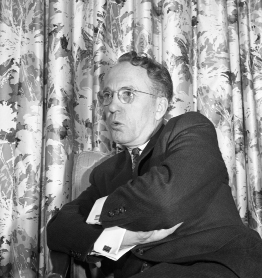
"In the last five years, great changes have taken place in the world. The old order is gone. We are living in conditions that are new and strange to us. Canada on the whole is like a young and vigorous man in the poorhouse. If you believe that things should be left as they are, you and I hold contrary and irreconcilable views. I am for reform. And in my mind, reform means government intervention. It means government control and regulation. It means the end of laissez-faire." — Prime Minister Robert Bennett
Canada‘s economy went from a model capitalist economy to a mixed economy. Entrepreneurs were still free to open stores and attempt to succeed in business. However, social programs were added to the economy to provide support and resources for the citizens of the country in times of need. It was hoped that social programs would help all Canadian citizens maintain a minimum standard of living. In this way, collectivist ideologies mixed with elements of free market economics. Canada’s mixed economy was born.
The first government in Canada to offer these social programs was led by Tommy Douglas. Douglas was the seventh premier of Saskatchewan and he later went on to become a Member of Parliament. Douglas saw the hardships caused by the Great Depression. He saw people die because they didn’t have enough money to see a doctor.
As a child, Douglas had a severe leg infection and amputation seemed to be the only solution. This was before penicillin was invented, and there was no easy cure for infection. A visiting specialist said he would operate on Douglas for free, as long as his students were able to watch the procedure.
Douglas’ amputation and his experiences in the Great Depression affected how he felt about health care. Douglas wondered why health care was only available to those who could afford it.
When Tommy Douglas became the premier of Saskatchewan, he fought to have the first socialist program introduced in a Canadian province. His dream of equal and free health care became a reality in 1946. He introduced the Saskatchewan Hospitalization Act, which gave free hospital care to most of the population.
Tommy Douglas was seen as a radical and a socialist. Many people in Saskatchewan and Canada opposed his ideas. How could such ideas be accepted in a classical liberal environment? Wouldn’t Canada be seen as a country becoming closer and closer to the Soviet Union’s communism?
Douglas believed in the common good. As the leader of the New Democratic Party, Douglas pressured the federal government, under the leadership of Prime Minister Lester B. Pearson, to adopt the Medicare Act in 1966. The Medicare Act made universal health care free and available to every Canadian.
As part of a CBC television competition in 2004, Canadians voted Tommy Douglas the greatest Canadian of all time based on his values of collectivism and caring for the common good.
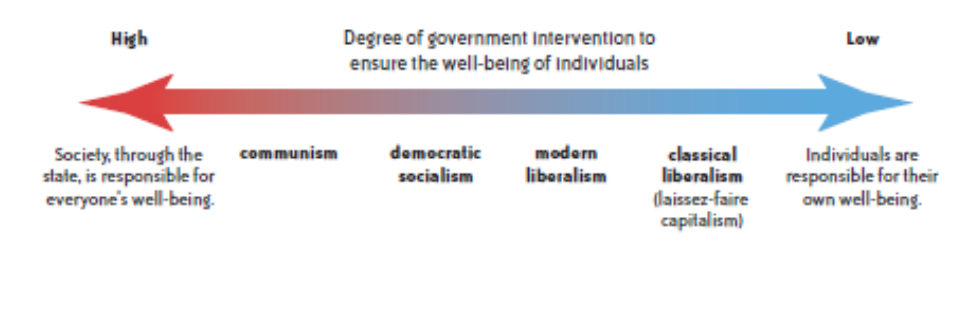
Governments began to adopt more and more interventionist policies by offering more social programs. Canada was following more left-wing policies, and the economy went from an economy based on classical liberalism to an economy based on modern liberalism.
The United States accused Canada of becoming communist. Americans felt their values of self-reliance were at risk because of their close neighbour’s interventionist actions.
The social programs offered to Canadian citizens have become part of Canada’s social safety net. The purpose of Canada’s social safety net is to catch the people who need assistance. The government believes it is the responsibility of all Canadians to guarantee a minimum standard of living to all citizens.
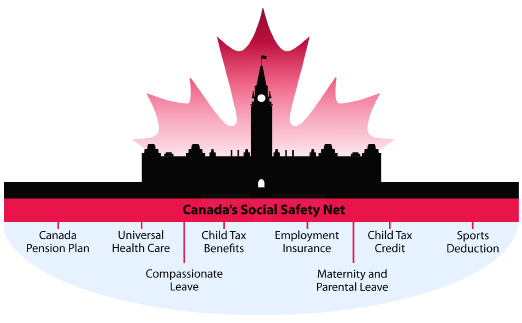
Taxes help pay for Canada’s social programs. Taxes in Canada are considerably higher than in the United States; however, many more social programs are available to Canadians.
In Canada, consumers and businesses have a large role in running the economy. Since 1945, Canadians have accepted that not everyone has the means to help themselves.
Canadians believe it is everyone’s responsibility to care for people in need. Canadians also believe that social programs, although offered through high taxation, help people who need help caring for themselves.
Some governments care for their citizens from cradle to grave.
Other countries have adopted social programs like those offered in Canada. Sweden, for example, has adopted ideas that follow those of modern liberal economists. In Sweden, the government believes it should care for its citizens from cradle to grave. From the moment a child is born to the moment of death, that person is provided with the help she or he needs to achieve a minimum standard of living.
These social programs include parental leave, employment insurance, universal healthcare, pension, care for the disabled, and subsidized post-secondary education. Sweden is often referred to as a perfect example of a welfare state because the country looks after the welfare of all of its citizens while allowing for a high level of private enterprise.
Offering such programs comes at a high price. Sweden has adopted a policy of progressive taxation, and Swedes pay the highest rate of taxes in the world. In Sweden, the more money you make, the more taxes you pay. This policy has not discouraged Swedes from working or getting an education. Swedes enjoy a low level of unemployment and a high standard of living. For these reasons and others, in 2022, the United Nations ranked Sweden as the fourth-best country in the world.
Canada and Sweden both have mixed economies. The main difference between the two countries is the degree of taxation and the level of government intervention.
Cradle to grave: from the time a person is born until the person dies
Mixed economy: an economic system in which free-market principles are combined with some degree of government intervention, usually to regulate the industry, moderate the boom-and-bust nature of the free-market business cycle, and offer social welfare programs.
Progressive taxation: a system of taxation in which the more money a person makes, the more tax that person pays
Subsidy: money people pay to the government. The government uses money from taxes to fund social programs for all Canadians
Throughout this lesson, you considered the following question: How have mixed economic systems embraced liberalism?
Modern liberal governments want to meet the political and economic needs of the people. The degree of government intervention in the economy differs from one country to another. Some governments provide more social programs than others. Social programs are funded by taxation.
Social programs meet the economic needs of the people by guaranteeing a minimum standard of living for all members of society. Although some governments offer these programs, the governments don’t interfere in the day-to-day activities of the economy. The governments of these countries have found a good balance between public and private enterprise.
Where does the speaker fall on the spectrum?
"A society based on self-interest and the accumulation of wealth ignores disadvantaged members of the community. The state must take an active role to serve the greater good."