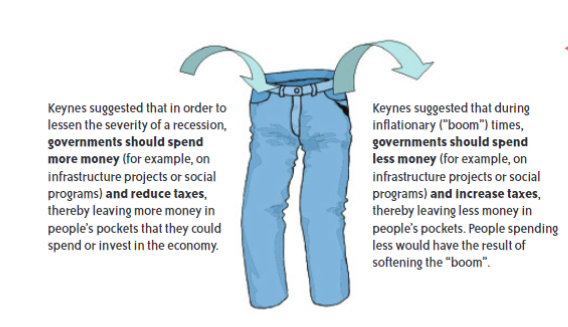
During times of crisis and need such as right now during the pandemic, in 2008 and the Great Depression, governments in North America had to contend with how to support people through the crisis. Previously you read how even the USA went to great lengths to create programs during The Depression to give people jobs and get them back on their feet. Few of those programs exist still today while here in Canada, some of the ideas that came out of that time period are cornerstones of our society today.
The idea of the government providing jobs and services for people sounds good on the surface, but could there be some drawbacks as well? Who or how are we going to pay for those services?
In the latter half of the 20th century, many people began to question the interventionist policies that took hold in the Great Depression and continued to expand, guided by governments influenced by the theories of John Maynard Keynes.
Let’s start by briefly reviewing Keynesian economics. The video below will provide some insight into the problems associated with the application of Keynes’ theories.
By the 1970s, the system of managed exchange rates broke down. Inflation rose, economies stagnated, and unemployment in many countries soared. Many Western nations were experiencing financial difficulties. Keynesian ideas no longer seemed to work, and Keynes’s critics started to attract greater attention. Governments had found that the cost of maintaining the welfare programs they had built was unsustainable without raising taxes. This led to many countries looking toward a different economic model. The two most prominent economists were Austrian-born Friedrich Hayek and Milton Friedman.
Hayek argued that government action often did more harm than good. This is he said that in economic terms, was harmful by inhibiting the operation of market forces, and in political terms; by reducing the freedom that individuals and companies should enjoy earning, spending, and generally acting as they chose.
Milton Friedman during the 1950s, tried to solve problems (unemployment, inflation) that Keynesian economics seemed to miss or create. Friedman believed it was essential to control the supply of money.
He proposed that governments should:
Basically, free market capitalism was back in vogue and, to ensure the market was as free as possible, many conservative governments began to reduce government regulation of business. By the 1980s Keynesian economics was out and monetarism and supply-side economics were in. Governments began cutting taxes and spending. The power of labour unions was often curtailed. Some governments began to run surpluses and even whittle away at public debt.
Both Friedman and Hayek, like Adam Smith before them, believed that the price system, or the free market, was the only way to balance supply and demand in the economy while maintaining individual liberty.
From my point of view, we in the United States have gone overboard in respect to the extent of regulation and detailed control of labor standards, industry, and the like. It’s bad for us...I am in favor of cutting taxes under any circumstances and for any excuse, for any reason, whenever it’s possible.
—Milton Friedman, 2006, in John Hawkins, “An Interview with Milton Friedman.” Right Wing News.
Two of the most famous adopters of supply-side economics were Ronald Regan in the USA and Margaret Thatcher in the UK.
In terms of the general thrust of their policies, both leaders tried to shift the centre of the political spectrum sharply to the Right. Reagan set about undoing a half-century of legislation that had built up the public sector while opening up America to expansion led by the private sector. Mrs. Thatcher busied herself with doing the same in Britain. Both leaders believed that the government itself was partly the cause of their mutual economic problems, including high inflation and slow economic growth, the answer being less government.
Their policies:
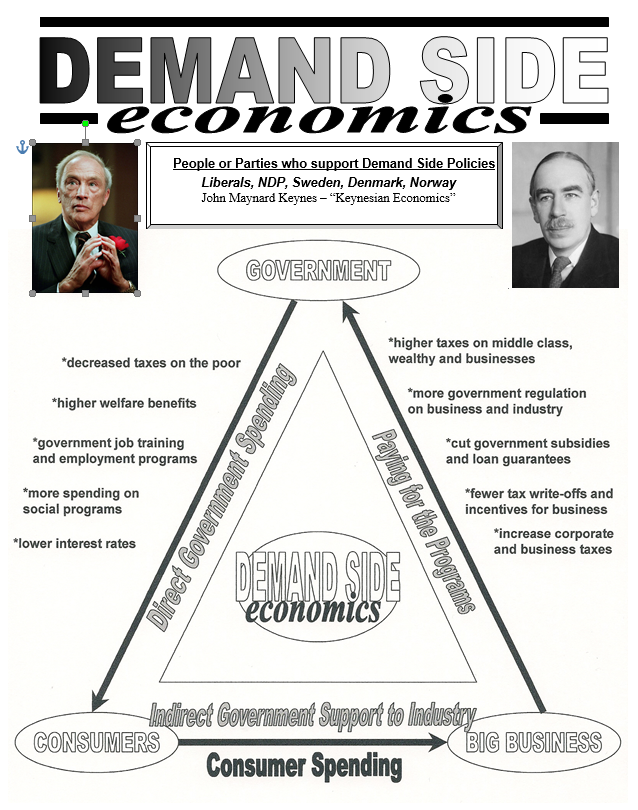
Demand Side Economics: the theory that the demand for goods and services drives economic activity
Neoliberalism: a political approach that favors free-market capitalism, deregulation, and reduction in government spending
Macroeconomics: the part of economics concerned with large-scale or general economic factors, such as interest rates and national productivity.
Microeconomics: the part of economics concerned with single factors and the effects of individual decisions
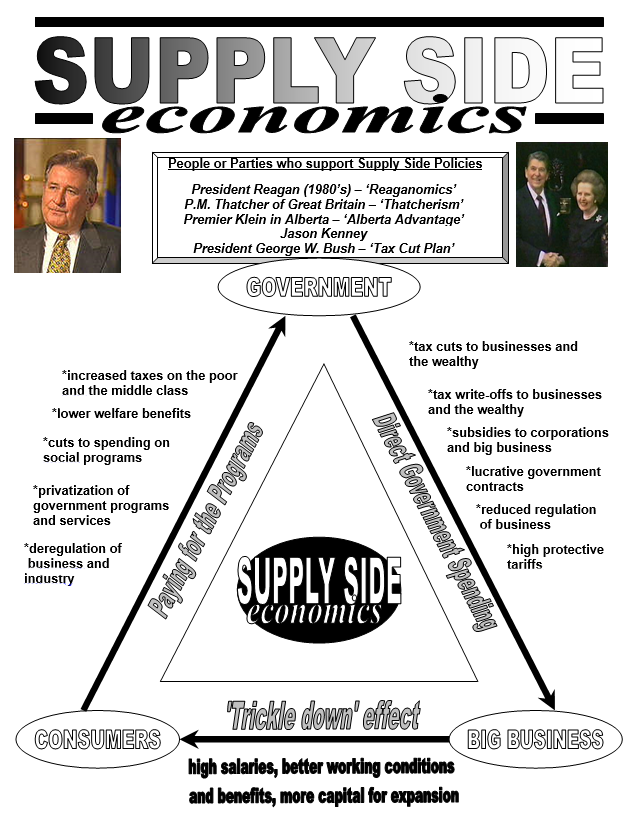
Supply Side Economics: the theory that maintains that decreasing taxes will increase the supply of goods and services for economic growth
Supply-side and demand-side economics are theories that aim to help the nation's economy. By researching economic theories and how they're used, you can develop a better understanding of how government practices affect economic growth for businesses and consumers.
Despite their differences, both supply-side economics and demand-side economics aim to inspire national economic growth and prosperity.
The supply side and demand side also want to encourage more job opportunities to influence economic growth. Supply-side economics aims to incentivize businesses with tax cuts, whereas demand-side economics enhances job opportunities by creating public works projects and other government projects.
Both supply and demand economics use reducing taxes as a method to stimulate the economy. This is because it increases the amount of spending money an individual or business entity can use toward purchasing goods and services.
Supply-side economics and demand-side economics can both make use of government projects or incentives to stimulate the economy. Supply-side economics usually focuses on creating government projects to encourage the production of goods from a corporation. In contrast, demand-side economics focuses specifically on creating government jobs, so consumers feel more comfortable spending.