Karl Marx, a socialist, is credited with being the father of communism. Communism is a form of socialism because the needs of the collective, or all members of society, are more important than the needs of individuals in society.
Socialists and communists believe that taking care of all members of society is the primary goal of government.
Key economic values of socialism and communism include the following:
Marxism, socialism, and communism grew in popularity because people hoped these ideologies would better serve the needs of people and erase the classical liberal ideas of capitalism and exploitation.
Today there are many different types of socialist governments, but all forms originated from Marxist beliefs.
In this lesson, you will become familiar with different forms of authoritarian governments. This lesson will help you identify, analyze, and respond to policies and structures within your own country that makes us question things.
In this lesson, you will explore the question: What are the different forms of authoritarian governments?
Throughout history, authoritarian regimes have been directly responsible for the suppression of human rights and for countless deaths and atrocities. These brutal dictators were responsible for the imprisonment and murder of millions of people. Under these regimes, men, women, and children were shot, starved, worked to death, or gassed.
In this lesson, you will examine the following question: What are the methods authoritarian governments use to stay in power?
Force and terror are extreme methods used by authoritarian governments. Force and terror cause such fear in society that no one is willing to break any laws for fear of the harsh treatment that will follow.
In authoritarian regimes, the police force does not maintain law and order for the protection of the citizens. Instead, the police force maintains law and order to benefit the wishes of the leader. In many countries, there are no police forces because each country is under the control of an army.
The military arrests and detains individuals suspected of committing any kind of crime. The military does not need any kind of proof, and citizens can be detained for long periods without going to trial. Citizens are terrified of being arrested and imprisoned. Force and terror are used to keep citizens obedient.
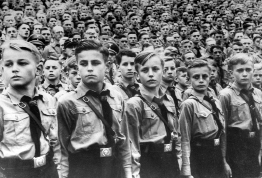
Indoctrination is the intentional use of media and education with the sole purpose of having a group of people believe in a common ideology. Authoritarian governments use indoctrination because original and creative thought serves no purpose to the leader. Conformity is obedience, and obedience is control.
Indoctrination is most successful when it is begun at an early age. Hitler created the Hitler Youth Movement which created perfect little fascists. Children who had grown up in the Hitler Youth Movement became the fiercest soldiers in battle during World War II. Indoctrination offers the government the ability to control the thoughts and actions of citizens.
Controlled participation happens when the government holds events that give participants the illusion that they are freely participating in the event. Often, participation in an event is mandatory; if a person does not attend, the person’s absence may be questioned.
Events can include large rallies, as were held in Nuremberg under Hitler’s rule, or regular elections where voters’ names are written on the ballot. These events give the illusion that the majority of citizens support government actions of their own free will.
Censorship is used to limit the amount of information that is available to the citizens of a country. Canadians experience censorship in the way videos or movies are rated. Countries under authoritarian or totalitarian governments censor newspapers, radio and television programs, books, and any other form of media.
Censorship occurs when the leader of a country does not want the people of that country to be aware of what is happening outside of the country. Through censorship, many communist countries convinced their citizens that capitalist countries were inferior to communist countries.
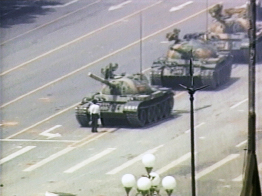
The single-party rule is a type of political system that does not tolerate the existence of any other political parties. The single-party rule exists when leaders fear parties that represent a different point of view and would oppose government policies. By having only one political party, there is group conformity in thoughts and actions. The leader in a situation of a single-party rule will never hold elections, and his or her term in office normally comes to an end after a coup d’état.
The photograph shown is not an image of the leader of a country under single-party rule. However, the image does show how the government reacts to individuals or groups of people who oppose the regime. The man standing before the tank is not sure that the tank will stop.
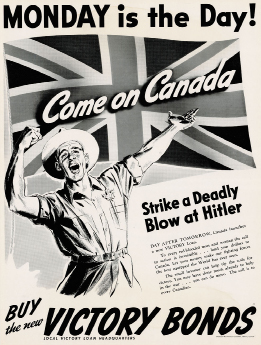
Propaganda is the use of media to inform and convince people of a message or an ideology. Propaganda is used in liberal and authoritarian governments and can be used positively or negatively. In democratic countries, propaganda is used to convince the population that certain actions are necessary and even to guilt individuals into taking a certain action, such as quitting smoking. In countries ruled by an authoritarian government, propaganda is often used to convince the population of the leader’s greatness and success. Authoritarian governments are often less honest in their propaganda campaigns.
Propaganda is normally spread through posters, announcements on the television or the radio, and even through lessons taught in the classroom. Joseph Stalin, the leader of the Soviet Union from 1925 to 1953, had movies made to make him one of the great leaders of the Russian Revolution—even though this was not true.
Scapegoating is the practice of blaming one group of people for the problems the government might be having regarding the economy, political situation, or war effort. Often, minority groups are the victims of scapegoating. In many instances, minority groups, or scapegoats, are blamed and persecuted for events that were never under their control. Under Hitler’s Nazi Germany, Jewish people were the victims of scapegoating.
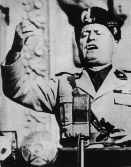
Authoritarian forms of government do not provide all of the democratic, civil, and human rights and freedoms that are typically associated with modern liberal democracies. Many authoritarian leaders give themselves special titles that distinguish them from leaders of other authoritarian governments.
Authoritarian governments come in a variety of forms.
The word dictatorship is often used to describe any form of authoritarian government. The term dictatorship refers to a specific kind of authoritarian system. A true dictatorship is an autocracy, where governmental power, or decision-making, is concentrated in the hands of one single person.
Dictators will have advisors with whom they can discuss issues; but, in the end, the dictators can decide without consulting anyone. You may be familiar with some of the dictators photographed in this lesson. Today, there are more than 70 countries that are ruled by dictators. Not all dictatorships are alike. In the following examples, you will learn about the different forms of authoritarian governments.
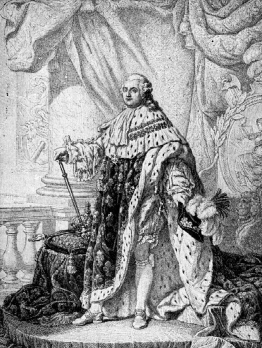
Absolute monarchies are a form of dictatorship. The king or queen is the head of the government and has absolute authority over the people in the country. Absolute monarchs normally come to power by hereditary means. Sometimes, their rise to power comes through marriage.
The head of an absolute monarchy does not follow a constitution or any specific set of rules. The monarchy may have created a constitution, but these rulers are above the law, meaning they do not need to follow the laws.
You may remember studying Louis XVI in Social Studies 20. His family ruled France for hundreds of years. The end of the family’s reign came about as a result of the people organizing themselves and overthrowing the monarchy to create a more democratic, liberal system of government.
An oligarchy is a government run by a small group of unelected individuals. In an oligarchy, there may be a leader, but that leader will rely on the support given by advisors. An oligarchy formed by military officers is referred to as a junta. Since the military officers have control of trained soldiers and heavy weapons, juntas are frequently established through a coup d’état in which the existing government is overthrown by force.
Totalitarian governments can be dictatorships or oligarchies. They are one or the other based on the degree to which the government exercises control over the population. In some dictatorships and oligarchies, the leadership may be primarily focused on maintaining political power and perhaps increasing their wealth. The average citizen might be able to avoid getting into trouble by simply following the rules.
These forms of government are very intolerant of anyone who opposes the control and power of the leader. Citizens can best preserve their safety by simply going about their daily business without criticizing the government or otherwise drawing attention to themselves.
In a totalitarian system, the government imposes its ideology on all citizens. You can be sure that this ideology does not reflect any of the values associated with liberalism.
Hitler was a totalitarian leader because his regime did not tolerate political opposition. He controlled the thoughts and the will of the citizens of his country. His ideology, fascism and the superior race, took precedence over tolerating the will of the people. Hitler’s political and economic beliefs will be explained in greater detail in the next two sections of this module.
Authoritarian: a form of government in which the leader is not elected and does not respect the will of the people
Absolute monarchy: a form of monarchy in which the monarch rules in their own right or power.
Autocracy: a system of government by one person with absolute power
Censorship: restricting freedom of expression or freedom of access to ideas or works, usually by governments, and usually to protect the perceived common good; may be related to speech, writing, art, religion, or military matters
Coup d’état: French for 'stroke of state', also known as an overthrow, seizure, and removal of a government and its powers
Dictatorship: a form of government in which one person or a small group possesses absolute power. Dictators, who are not accountable to the citizens over whom they rule, often use force or fraud to gain political power, which they maintain through intimidation, terror, the repression of civil liberties, and propaganda
Fascism: an authoritarian system of government (a dictatorship) that includes extreme militaristic nationalism, a belief in the rule of elites, and a totalitarian society in which individual interests are subordinated to the good of the nation-state. Fascism rejects the ideas of both liberal democracy and communism or socialism
Indoctrination: the process of teaching a person or group to accept a set of beliefs uncritically
Junta: a military or political group that rules a country after taking power by force
Oligarchy: a small group of people having control of a country, organization, or institution
Propaganda: information, especially of a biased or misleading nature, used to promote or publicize a particular political cause or point of view
Scapegoat: a person who is blamed for the wrongdoings, mistakes, or faults of others
Totalitarian: relating to a system of government that is centralized and dictatorial and requires complete subservience to the state
In this lesson, you explored the following question: What are the methods authoritarian governments use to stay in power?
Throughout history, dictators have used different methods to gain and especially maintain power. The people are not always wilful participants in the actions of the government. Most often, the mere threat of the use of force and terror is enough to make unwilling participants change their actions just to survive in such a society. Often, the will to survive can be stronger than the will to rebel.
Authoritarian leaders are willing to use any means to stay in power. These corrupt governments do not exist to serve the will of the people and do not place any priority on respect for individual life. These governments will use any means to program the citizens of the country into adopting the government’s political, economic, or military initiatives.
Authoritarian leaders see themselves as being superior beings with superior visions, and they are willing to use extreme measures to remain in power.
Below are two interpretations of what it would be like living under an authoritarian regime. The first is a real-life account of someone who lived in the Soviet Union for two years, and the second is a famous short story by Kurt Vonnegut called "Harrison Bergeron".
Consider how the ideas expressed compare/contrast with the ideas that Marx and others were trying to address with their ideals.
Source 1:
Source 2: