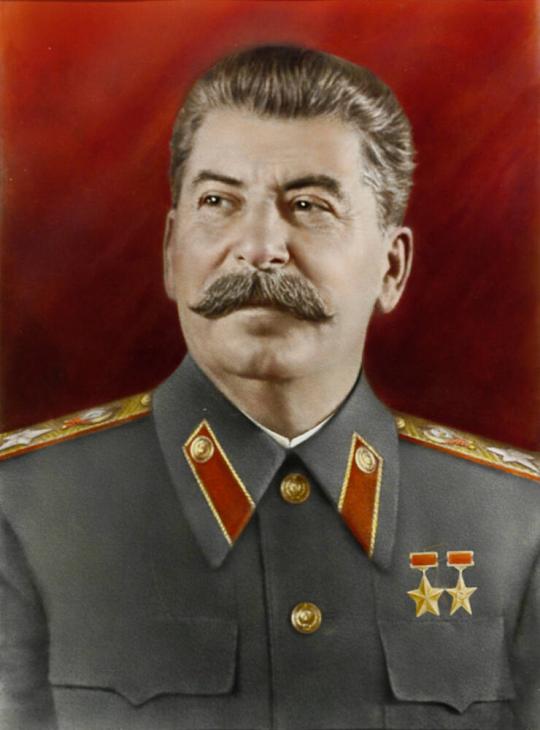
"Death solves all problems - no people, no problem" — Joseph Stalin
After Lenin’s death, Joseph Stalin came to power in the Soviet Union. Stalin wanted to establish a fully realized communist system in the Soviet Union and eventually across the world. Stalin took Lenin’s ideas of communism to the extreme. Like Lenin, Stalin dreamed of harmony and freedom. But Stalin’s version of harmony and freedom was more different from Lenin’s vision than anyone could have expected.
Stalin led a totalitarian form of dictatorship. There was only one legal political party in the Soviet Union—the Communist Party. Opposition political parties were not allowed, and people who opposed or criticized Stalin were imprisoned or eliminated. Stalin demanded total obedience and control. He believed that he knew what was best for the Soviet people.
According to the Soviet constitution, every Soviet citizen was allowed to vote. Elections would be held every four years and the country would be led by the Supreme Soviet. The Supreme Soviet was an elected body of Soviet officials that would represent the will of the people in the Kremlin. The Supreme Soviet would choose the members of the Cabinet. The Cabinet would be led by Stalin who was the Secretary, or leader, of the Communist Party.
Although there were elections in the Soviet Union, they were infrequent and meaningless. Only members of the Communist Party were allowed to vote, and not all citizens in the Soviet Union were Party members.
Stalin controlled who belonged to the Communist Party. Only Soviet citizens who proved themselves to be valuable to Stalin were allowed to be members of the Communist Party. Only between 4 to 10 percent of the population belonged to the Communist Party. The Supreme Soviet only met once or twice a year and only met for a couple of days each time. This gave the Soviets the illusion that their voices were being heard, but the Supreme Soviet did not influence political decisions that would ultimately be decided by Stalin.
Although the Soviet Union had a constitution, very little emphasis was placed on respecting the contents of that constitution. The contents of the constitution included freedom of speech and freedom of the press. Both speech and the press were controlled by Stalin, and there was never any opposition to his power, written or spoken, that went unpunished.
Due to the strict control of the people and Stalin having all of the power in the country, it is said that the Soviet Union was ruled with an iron fist. Opposing political parties were not allowed, and imprisonment and exile were common punishments for holding political beliefs that were not the same as Stalin’s.
Under Stalin’s rule, the only legal political party in the Soviet Union was the Communist Party. If all candidates from the Communist Party held the same view, there would be no need to have more than one name on a ballot. Yet, regular elections continued.
You know, comrades, that I think in regard to this: I consider it completely unimportant who in the party will vote, or how; but what is extraordinarily important is this—who will count the votes, and how. — Joseph Stalin
Totalitarian forms of government use different means to obtain and maintain power. Keep reading to learn more about the methods Stalin used to maintain power in the Soviet Union.
Many authoritarian forms of government used a technique called a Cult of Personality. The technique is built on the fact that a population extremely devoted to its leader is more willing to obey that leader. In turn, the leader has obedience from, and control over, the people.
Stalin knew that he must make himself be seen as the true saviour and leader of all Russians. He exaggerated the role he played in the formation and existence of the Soviet Union.
Stalin created a cult of personality by taking the following actions:
Stalin believed that the best way to rule his people was with an iron fist. The more control he exercised over his people, the easier it was to control them. Stalin established the KGB, and he placed secret police throughout the cities and the countryside. Those people who opposed Stalin, disobeyed the law, or went against the Communist Party were imprisoned, exiled, or executed.
Soviets were often arrested, detained, and tortured for many different reasons. Family members would disappear for days or weeks at a time. When they returned, their personalities changed. They were mentally and physically abused by the police. They would be returned home to serve as an example of what could happen if an individual went against Stalin and his regime.
Stalin used many different methods to control thoughts and beliefs. Books, magazines, radio, television, films, and the theatre were under Stalin’s strict control. Books were not allowed to reflect anything but the Communist Party’s ideology. Movies and the theatre could only portray the greatness of Stalin and the Communist Party’s regime. Although Stalin did not play an important role in the Russian Revolution, he changed history books and classroom textbooks to show that he was a leader during the Russian Revolution. These were all forms of censorship.
Stalin depended on indoctrination. Since the media could only present the Communist Party’s point of view, Soviet citizens were not exposed to other points of view. Only Soviet music was played, and the theatre and movies depicted Stalin’s Soviet Union as a glorious and free country. Soviets were never told the truth about the tragedies that affected them.
Schoolchildren were taught to adore Stalin and what he had done for the Soviet Union. The Communist Youth Movement was started for children as young as eight years old. Churches were closed and converted into schools and movie theatres.
Stalin had many different levels of police. There were the local police, the block police, and the state police. Citizens did not have to commit any real crime to be arrested. Sometimes citizens were arrested because they were friends with someone who had ties to an illegal political movement. A member of the secret police could be sitting at your kitchen table and you would not know. This fear kept the Soviets insecure so they rarely spoke against Stalin’s regime.
Between 1937 and 1938, Stalin’s need for power increased. He became paranoid and believed that his leadership was threatened. He was afraid that his military leaders and members of his government were plotting against him and wanted to take control of the Soviet Union.
To protect himself, Stalin arrested his top generals and members of his government. Millions of ordinary citizens were also purged for their beliefs. Most of these people were sent to the gulags. These purges did not always serve Stalin well. He was often left with inexperienced political and military leaders who made bad decisions based on a lack of experience.
Over 100 000 priests and nuns were killed during the Great Purge. Any threat to Stalin’s power was eliminated.
Gulags began as prisons, but they soon became forced labour camps where many enemies of the state were sent for punishment. These “enemies” did not have to do anything wrong politically, they just had to oppose any of Stalin’s harsh laws. As Stalin had more and more Soviets arrested, more and more of these camps were built.
Gulags served as cheap work camps. Prisoners were forced to work long hours, and they were promised freedom once the work was completed. In fact, very few prisoners were released from these camps. It is estimated that between 6 and 10 million people died in the gulags. It is estimated that well over 16 million Soviets passed through the doors of the gulags.
After Stalin arrested his generals, Stalin held trials that became known as show trials. Many people were arrested on false charges, and others were forced to confess to crimes they had not committed. The accused were tortured, and their families were threatened. The only way for the accused to protect themselves was to sign false confessions.
Stalin arrested some of the most intelligent people in his country for planning actions against his government. Most of these people were innocent of the crimes of which they were accused. These show trials did serve a purpose for Stalin. The Soviets were shown that Stalin would not tolerate any opposition from any member of society—even those people closest to him.
Stalin’s communist dictatorship rejected all forms of liberalism. Stalin believed he was the best leader for his country and that he was the only person who could make good decisions. Stalin believed that democracy was a form of government that allowed the weak to govern and make decisions that would not best serve the country. Stalin’s elite included people who would obey his orders. However, as demonstrated in the purges, Stalin did not even trust the advisors he chose. Stalin alone was elite.
In 1953, Stalin died at the age of 74. Millions of Soviets lined up to give their final goodbyes to Stalin at his funeral. Soviets cried when they heard of his death. Some cried from the joy they felt for finally being free of such a leader. Many others cried because they did not know how they could live without Stalin’s leadership. Stalin had controlled Soviet thought for so long that many Soviets no longer knew how to think for themselves.
Gulags: a system of Soviet labour camps and accompanying detention and transit camps and prisons
Indoctrination: the process of teaching a person or group to accept a set of beliefs uncritically
KGB: Soviet secret police and intelligence agency
Purge: removal of individuals who are deemed to be a threat to power or a menace to society
In this lesson, you explored the following question: How did the authoritarian system in the Soviet Union reject liberalism?
Stalin rejected all forms of liberalism. There was no opportunity for debate and discussion under Stalin’s oppressive rule. Stalin was not interested in listening to the will of the people. His slogan, “No people, no problem,” sums up his attitude toward the Soviets.
Stalin did not value the lives of the Soviets; he saw the people mainly as a means to create a larger empire. His authoritarian form of government did not allow for dissent or the formation of other political parties. Stalin rejected all forms of liberalism by creating secret police, transforming the prisons into work camps in the gulags, and creating laws that limited the rights of Soviet citizens.
Show trials, Stalin’s re-creation of historical events, the purges, and his constant use of force and terror show that Stalin had no respect for individual liberty. He used any means he could to attain his objective—complete domination of the people.
You have probably noticed that Stalin did little to follow the will of the people. Identify how Stalin rejected the will of the people. Why does he do so?
You may want to access the following additional resources.