On or about February 24, 1848, a twenty-three-page pamphlet was published in London.
"Modern industry, it proclaimed, had revolutionized the world. It surpassed, in its accomplishments, all the great civilizations of the past—the Egyptian pyramids, the Roman aqueducts, and the Gothic cathedrals. Its innovations—the railroad, the steamship, the telegraph—had unleashed fantastic productive forces. In the name of free trade, it knocked down national boundaries, lowered prices, and made the planet interdependent and cosmopolitan. Goods and ideas are now circulated everywhere. Just as important, it swept away all the old hierarchies and myths. People no longer believed that ancestry or religion determined their status in life. Everyone was the same as everyone else. For the first time in history, men and women could see, without illusions, where they stood in their relations with others.
The new modes of production, communication, and distribution also created enormous wealth. But there was a problem. The wealth was not equally distributed. Ten percent of the population possessed virtually all of the property; the other ninety percent owned nothing. As cities and towns industrialized, as wealth became more concentrated, and as the rich got richer, the middle class began sinking to the level of the working class."
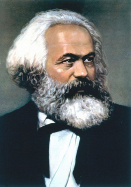
Soon, there would be just two types of people in the world: the people who owned property and the people who sold their labor to them. As ideologies disappeared which had once made inequality appear natural and ordained, it was inevitable that workers everywhere would see the system for what it was, and would rise and overthrow it. The writer who made this prediction was, Karl Marx, and the pamphlet was “The Communist Manifesto.”
In this lesson, you will explore the foundations of socialist and communist ideology. You will be introduced to key individuals associated with both of these ideologies.
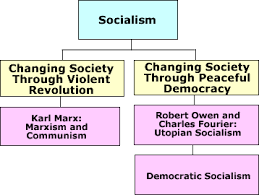
In the eighteenth century, many societies wanted to put an end to the negative aspects of an economic ideology based on capitalism and free market values. Some people believed that the only way to help society was through an economic ideology called socialism.
Socialists believe in economic equality based on the common good. They believe all people in society should be cared for; not just those who have been more fortunate than others. Socialists believe that all members of society need to contribute to the care of the elderly, the young, the physically and the mentally challenged, the unemployed, and all other people who may need special consideration.
Communism and Socialism; terms are often used interchangeably. In a way, communism is an extreme form of socialism. Consider that many countries have dominant socialist political parties but very few are truly communist. Within a socialist system, capitalism CAN exist (e.g. privately owned companies); while in a communist system capitalism, CANNOT exist.
In a socialist economy, the government provides for the people. The taxes are usually higher than in a capitalist system. There may be government-run health care and a complete system of government-operated education. It is a misconception that people do not pay for these services. They do pay for them through higher taxes. Socialist systems emphasize a more equal distribution of wealth among the people.
Robert Owen, a factory owner in New Lanark, Scotland, changed the way factories were run and operated. He believed in improving the working and living conditions in his factory.
Robert Owen was a social and educational reformer. He remains a controversial and mysterious figure. Having profited enormously from his businesses in the early Industrial Revolution he set about trying to fix the problems of the time through environmental, educational, factory, and poor law reforms.
He called for widespread social change in society, with education at its core. New Lanark, a village in Scotland became internationally famous for his ideas.
After his changes in Scotland, Robert Owen took his ideas of a Uptonian society further and moved on to the USA where rather than profit, cooperation would be the main focus of the town. He attempted to establish a 'Community of Equality' in New Harmony in Indiana.
New Harmony was to be a place in which all people would live in communities of self-sufficiency and cooperation. Education, technology, and teamwork would shape citizen prosperity and happiness. He dreamed of a secular society that had no religion. In his blueprint, women were equal to men. The environment, not heredity, would be responsible for everyone's shared good fortune. No longer would people face competition to discover success or rely on organized religion to lead a moral life.
The principles of the community were explained here: "Within the community, all work was to be equal. One was to receive that which was necessary to him. The teachers' work was to be on the same footing as the laborer, the farmer the equal of either. All were to perform to the best of their ability and receive the same compensation."
It was, as Owen put it, the perfect model of “utopian socialism.” And it failed less than two years later.
Its residents lacked the motivation to work, while its government was unable to manage even the town’s one general store. “[E]ven salads were deposited in the store to be handed out,” one New Harmony resident wrote, “making 10,000 unnecessary steps [and] causing them to come to the tables in a wilted, deadened state.”
The community couldn’t produce enough food to be self-sufficient, primarily because when its hardest-working members realized that they would earn the same benefits as the laziest, they stopped working. With no new houses being built for the growing community and food shortages becoming an epidemic, homelessness, and famine ran rampant. There were rules for when to bathe when to eat when to sleep. In all, just too much for people to have to respond to.
Next, you will learn about how another man, Karl Marx, took this community-based ideology to another level.
Karl Marx studied the principles of socialism and utopian socialism. Marx believed the hardships and inequalities that had occurred during the Industrial Revolution needed to be stopped. He believed that society should not be based on the class system in which some people were richer than others. Karl Marx based many of his ideas on the lessons learned at Robert Owen’s factory.
Karl Marx was born in Germany in 1818. He grew up during the time of the Industrial Revolution. He saw the changes that were occurring—worsening working conditions and extreme poverty—as problems that needed to be solved. His solution, however, was different from other socialists of the time.
Karl Marx, a socialist himself, predicted that there would be a class struggle between the working class, or the proletariat, and the factory owners, or the bourgeoisie. He believed that the working class would eventually become tired of being exploited. Eventually, the proletariat would rise in a violent revolution against the bourgeoisie and the factory owners.
Karl Marx’s ideology became known as Marxism. Marxism was based on socialist principles and was a rejection of classical liberalism and the unjust and harsh economic conditions brought about by the Industrial Revolution. Although Karl Marx was never the leader of a country, he did envision how his ideas could be adopted by a country.
Examine the following table of Marxist ideas. The table provides an outline of conditions and events Karl Marx thought were necessary to establish a truly socialist country with economic equality.
| Marxist Ideas |
|---|
|
Marx did not believe that private ownership of land and property created a just society that met the needs of all people. Marx believed in the common good of all people and that everyone should be treated equally.
Marx also believed that it was impossible to have economic equality without political equality. Once a true socialist and communist state was established, there would no longer be any reason for government. Everyone would work hard because everyone in society would benefit. Why wouldn’t society benefit?

Karl Marx, a socialist, is also credited with being the father of communism. Communism is a form of socialism because the needs of the collective, or all members of society, are more important than the needs of individuals in society.

Socialists and communists believe that taking care of all members of society is the primary goal of government.
Key economic values of socialism and communism include the following:
Marxism, socialism, and communism grew in popularity because people hoped these ideologies would better serve the needs of people and erase the classical liberal ideas of capitalism and exploitation.
Today there are many different types of socialist governments, but all forms originated from Marxist beliefs. Marism-Leninism and Stalinism developed in the Soviet Union, and Maoism developed in China.
| Political Ideas | Economic Ideas | Social Ideas |
|---|---|---|
|
|
|
Karl Marx believed that everyone in society would work hard so that all members of society could benefit from one another’s hard work. Some people work harder than others, and there is a huge variety of what is considered hard work. How would a socialist country deal with people who are not willing to work as hard as others? Can you see that there are some challenges for an ideology that believes everyone will work hard so everyone will benefit?
You have learned that liberal democracies are a relatively new phenomenon. In the past, individuals, such as kings and queens, made laws and ruled the land. Liberal democracies forced those governments to follow the rule of law, which gave political power to the people.
In 1998, Freedom House, an independent organization that promotes freedom around the world, announced that “40 percent of the world’s population now lives in free societies.” That means that, in 1998, 60 percent of the world’s people lived under governments that provide partial freedoms or no freedoms to their people.
In 2023, Freedom in the World recorded the 17th consecutive year of decline in global freedom. The reversal has spanned a variety of countries in every region, from long-standing democracies like the United States to consolidated authoritarian regimes like China and Russia. The overall losses are still shallow compared with the gains of the late 20th century, but the pattern is consistent and ominous. Democracy is in retreat.
In this lesson, you explored the foundations of socialist and communist ideology. You were introduced to key individuals associated with both of these ideologies.
Bourgeoisie: a French word that refers to the social class that evolved in Europe during the Middle Ages with the development of cities and the growth in trade.
Communism: an ideology based on the belief that the oppressed working class must overcome its property-owning oppressors through revolution so that together they can work towards becoming a classless society in which property is owned by the community and all people share in the production of goods and the benefits of production
Marxism: a socialist ideology that evolved from interpretations of Karl Marx's idea that the working class should overthrow the capitalist class and establish a classless society where the property would be owned by the state.
Proletariat: a term used by Karl Marx to refer to the class of industrial workers whose only asset is the labour that they sell to an employer.
Revolution: a sudden, radical, or complete change in political organization
Socialism: an ideology based on the belief that collectivist values should be the foundation for political, economic, and social life
Complete the review task: Communism and Democratic Socialism (PDF)
Consider:
You may want to access the following additional resources.