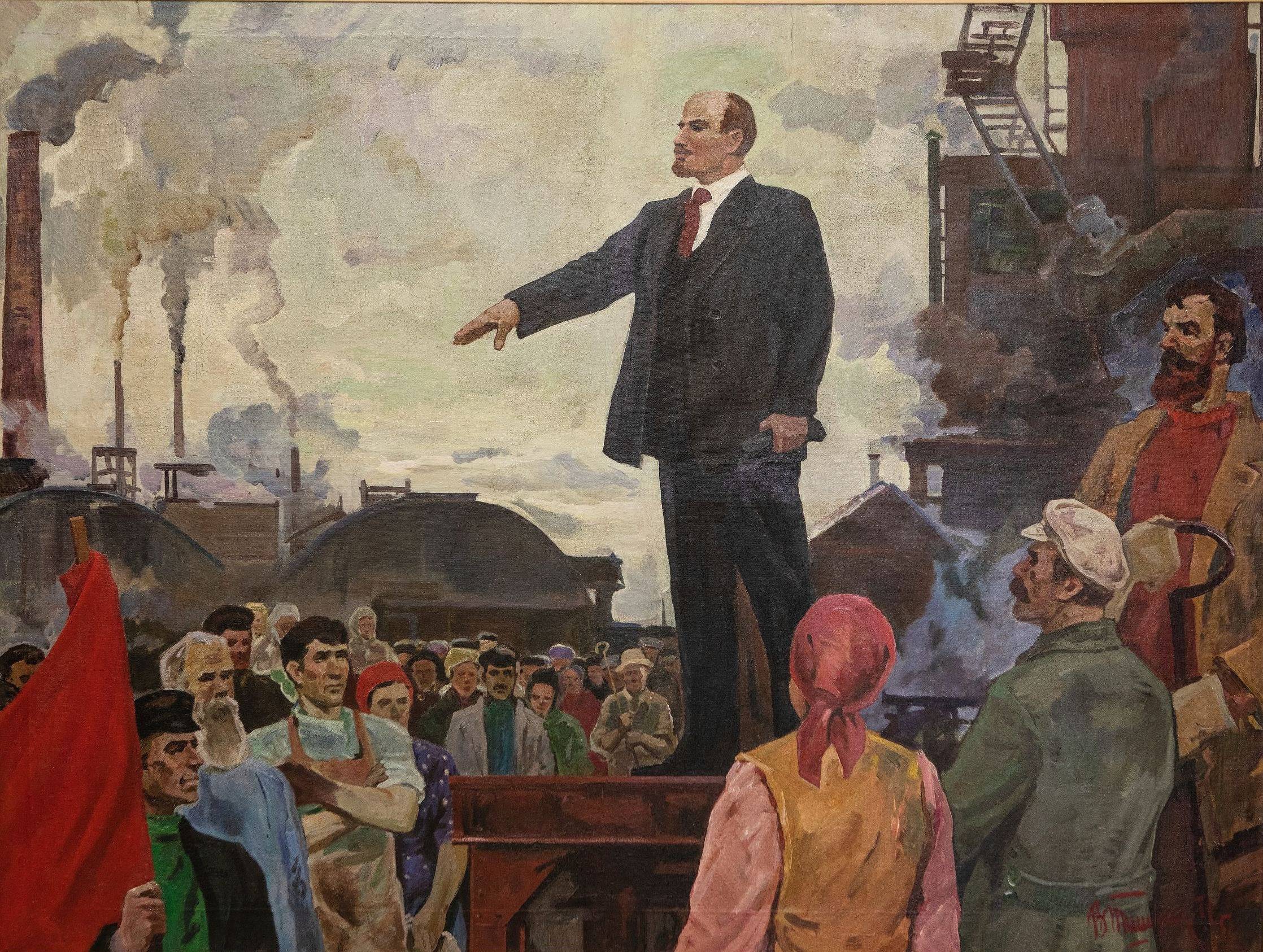
Imagine living in a country where everyone earns about the same amount of money—doctors, salespeople, cooks, construction workers, restaurant servers, lawyers, and others—all earn about the same amount of money regardless of their training or the difficulty of the job.
Under the Soviet communist regime, citizens believed that one job was no more important than any other job. If no one repaired the roads, cleaned the schools, or picked up the garbage, cities, and towns would become dirty and people would become sick. Communist societies are based on these ideas of economic equality.
In this lesson, you will explore the question: How did a command economy in the Soviet Union reject liberalism?
In previous lessons, you learned that the changes introduced by Lenin and Stalin after the Russian Revolution led to the start of communist rule in Russia. The government controlled society and the actions of citizens. Freedom was restricted and laws were passed to protect the power of the state. This lesson will explore how the economy was affected by a government that controlled all means of production.
Under the czarist regime of Nicholas II, industry and farming were mainly controlled by the monarchy. For the majority of Russian citizens, life was difficult because they worked for wealthy landowners or factory owners who paid them very small salaries.
Many Russians worked long hours in unsanitary factories. The future looked bleak. These factory workers did not believe there would ever be a change in their quality of life or in their working conditions. Also, very few peasant farmers owned land. Some parents did not earn enough money to feed their families. It was time for a change. The people had begun to ask themselves why the rich should continue to benefit from the work of the proletariat.
Before the Russian Revolution of 1917, Lenin and the Bolshevik Party promised “Peace! Land! Bread!” for all Russians, if elected. Lenin’s slogan meant he was interested in promoting three major changes for the people of Russia. The Russian people were ready to adopt the ideas of communism (a combination of Marxism and socialist principles). They were ready for a revolution!
When Lenin came to power, he nationalized the factories, meaning that the government took ownership and control of production and operations. Factory owners lost ownership of their factories, and new people were put in charge of managing and running the newly government-owned factories.
Lenin soon realized that the new managers did not know how to properly run a company. Production had decreased drastically and Russia was in trouble. Often Lenin had to replace the new managers with the former factory owners. The change was not happening the way Lenin had expected.
Between 1918 and 1921, Lenin introduced an economic policy called War Communism. War Communism was meant to control all means of production and all aspects of society. The first plan was to provide food for all Russians. There was a severe shortage of food and inflation was rising.
The price of products was increasing and the value of the ruble was decreasing. The farmers who had just been granted land were unwilling to sell food at a cheap price, and they kept the food they had produced. Lenin had to order his soldiers onto the farms to take the food by force. Many farmers protested and fought back against the soldiers.
Private enterprise was illegal. Farms and industry were to be under the strict control of the government. If a worker attempted to strike or oppose War Communism, that person could be shot without trial or the opportunity to defend herself or himself.
Food was to be distributed evenly amongst all citizens in Russia. Many people migrated from the city to the country, hoping to be able to better feed themselves and their families. From 1918 to 1920, the city of Petrograd lost 75 percent of its population and Moscow lost 50 percent of its population.
Because of the low value of the ruble and the fact that farmers would not sell their food, a famine occurred in Russia. The low value of the ruble decreased the amount of money available to buy products, and so factories closed. Those people who supported Lenin, his revolution, and War Communism turned against him. Lenin had no other choice but to bring an end to War Communism.
| Lenin's New Economic Policy |
|---|
|
Lenin introduced more changes to transform the economy once again. He realized that War Communism was not going to solve Russia’s economic problems. Maybe the Russians were not ready for communism or total government control. Production was at an all-time low and Lenin was afraid his fellow Russians would turn on him.
Lenin decided that a partnership between government and private enterprise would best benefit society. He introduced the New Economic Policy (NEP), which encouraged partnership between the government and private enterprises. He adopted two changes he thought would increase production—changes in agriculture and changes in factory production.
Russia became known as the Soviet Union in 1922. You may sometimes find the two names—Russia and the Soviet Union—used interchangeably.
Under the NEP, farmers were able to sell a portion of their crops on the open market. Crop production did increase from 22 million tonnes in 1922 to 72.5 million tonnes in 1925. Russians had food on their tables, and the famine was over.
The NEP allowed private entrepreneurs to open shops that employed fewer than 20 people. Small shops opened all over Russia. Shop owners could keep profits and determine what would be sold. To some extent, Lenin had liberalized the communist economy by allowing a measure of entrepreneurship.
Not everyone was happy with these changes. Many members of the Communist Party opposed these liberal practices. If the purpose of the Communist Party was to introduce economic equality, why was Lenin permitting and even encouraging private enterprise? Lenin died in 1924 before a solution to this problem could be found.
Russia became known as the Soviet Union in 1922. Imagine you were in Lenin’s shoes as the leader of the new Soviet Union during the NEP. You believed that War Communism would solve many of the Soviet Union’s economic difficulties. Members of Czar Nicholas II’s family had controlled industry and wealth. Under War Communism, there would be more economic equality. You believed that the Soviets would embrace economic equality. But there were problems.
Consider the viewpoints of whether different groups would have embraced the new liberal ideology of the Soviet Union. Why did Lenin find the transition from War Communism to the NEP necessary?
 Stalin, the Soviet Union’s leader after Lenin, did not agree with Lenin’s New Economic Policy. He did not agree with incorporating characteristics of a market economy in a centrally planned economy. Although both Lenin and Stalin incorporated ideas based on the ideas of Karl Marx, each had his own interpretation of how to lead the country.
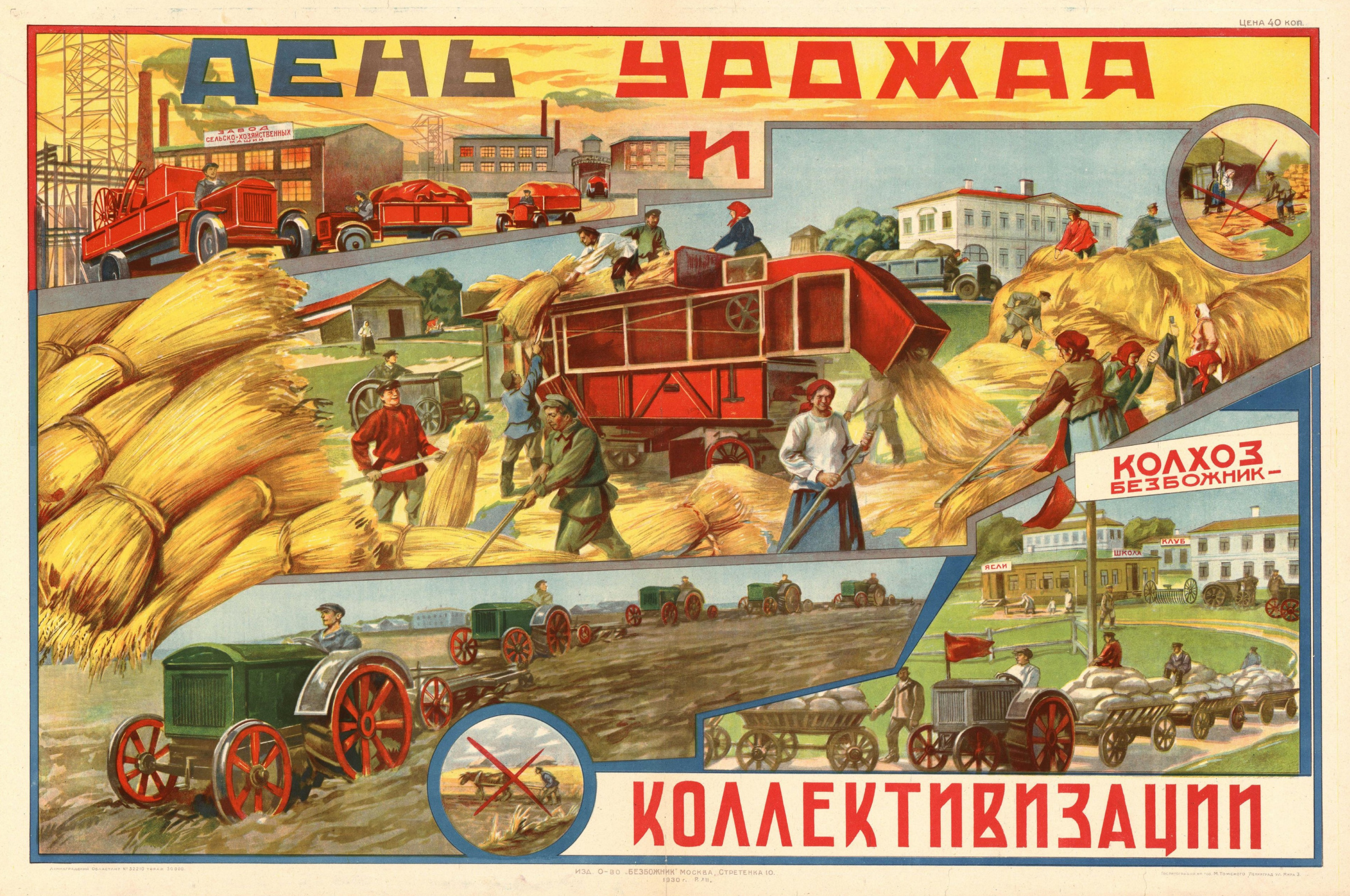
In 1929, in order to stabilize food production and reduce the amount of private ownership of land, Stalin introduced collectivization. In many areas of the Soviet Union, peasants were encouraged to combine small farms. Stalin believed that the resulting larger farms would waste fewer resources and produce more food. These farms became known as collective farms.
The large collective farms were run by government officials from the Communist Party. Farmers were given a quota for crop production. Once this quota was met, farmers were able to sell the surplus on the open market and share the profits with the other farmers of the collective farm. Quotas were usually unrealistically high, and they were rarely met.
The Gosplan was the Soviet Union’s central planning commission. The Gosplan was divided into different sections, with each section looking after its own needs. The Gosplan would determine the supply and demand of goods and services in the Soviet Union.
Production decisions were made by the Gosplan. The Gosplan had to match available resources with planned production quotas established in five-year plans. Since Gosplan established its production priorities for five years, there was no room for any flexibility in production. New demands for products were left to the next five-year plan.
The Gosplan was an inflexible organization that determined production for a set amount of time (normally five years). A factory would continue to produce goods until the managers were told differently.
It has been said that a factory continued to produce refrigerators that did not work properly for over 20 years. These refrigerators were placed in warehouses where they were kept for years. It seems no one told the company to stop producing these refrigerators.
Why would industry continue to produce goods that no one was purchasing? Shouldn’t the law of supply and demand have let the company know these refrigerators were no longer needed?
Five-Year Plans
In terms of industrial and economic development, the Soviet Union was between 50–100 years behind most other industrialized European countries. Stalin introduced the five-year plans to best plan how to catch up to these countries. Each plan had a specific goal. Stalin felt that, if industrialization was planned, the Soviet Union could industrialize faster using the plans. Stalin’s ultimate goal was to catch up to the European level of industrialization within fifteen years.
Stalin’s primary focus was on increasing food production and heavy industry (the exploration of coal and iron). Collective farms were created. If Stalin was going to industrialize his country, he needed to feed the people who would be working hard at developing industry.
Stalin’s five-year plans were disrupted when World War II began. During World War II, an emphasis was placed on the production of war materials. After the war, priorities were placed on the reconstruction of industry, roads, and railways damaged by fighting.
The Soviet people did not always meet the targets set out in the five-year plans. The targets were unrealistic.
Imagine being the foreman of a site where a bridge is being built. There is an order to how the bridge must be assembled. You are waiting for certain parts to be delivered, but they do not arrive on time. In fact, they will not arrive at all, because the Gosplan did not order the production of enough parts.
Once a month, a government inspector comes to see how the bridge is progressing. If production targets are not met, the foreman may be fired, imprisoned, or sent to the gulags. Because of the missing parts, you can’t complete your job. You are scared and so you pretend you have completed your job.
Often managers lied about how much was actually produced in a year. Lying gave the managers more time to come up with a solution. More often than not, the lies just bought time—the end result, punishment, was still the same.
Not all farmers wanted to join the collective farms. Many were forced into joining the farms. The kulaks were productive Ukrainian farmers who opposed collectivization. Ukraine was one of the 15 republics of the Soviet Union. The kulaks worked hard for what they produced. They refused to sell their grain at a lower price and they refused to give up their land. Why should the kulaks share everything they owned with less successful farmers? Why should they share their wealth?
Rather than sell their grain at a cheap price and share their lands and crops, the kulaks burned their crops and killed their animals in protest. Stalin had no patience for such disobedience. He ordered the liquidation of all kulaks. Over 6 million kulaks were executed or exiled to gulags because they opposed Stalin’s ideas of collectivization. Soviets were not made aware of this tragedy until the 1980s.
The Soviet constitution guaranteed full employment for all Soviet citizens. Soviets were often moved to other communities where they were needed. Not all Soviets were employed in an area where they were able to use their talents.
Much of the work was monotonous and, all too often, people had difficulty taking pride in what they produced. Creativity was not encouraged or needed. Soviets were paid whether they went to work or not. Often people would spend hours a day in line hoping to purchase goods that were very frequently in short supply.
After Lenin’s death, Joseph Stalin came to power in the Soviet Union. Stalin wanted to establish a fully realized communist system in the Soviet Union and eventually across the world. Stalin took Lenin’s ideas of communism to the extreme. Like Lenin, Stalin dreamed of harmony and freedom. But Stalin’s version of harmony and freedom was more different from Lenin’s vision than anyone could have expected.
Stalin led a totalitarian form of dictatorship. There was only one legal political party in the Soviet Union—the Communist Party. Opposition political parties were not allowed, and people who opposed or criticized Stalin were imprisoned or eliminated. Stalin demanded total obedience and control. He believed that he knew what was best for the Soviet people.
According to the Soviet constitution, every Soviet citizen was allowed to vote. Elections would be held every four years and the country would be led by the Supreme Soviet. The Supreme Soviet was an elected body of Soviet officials that would represent the will of the people in the Kremlin. The Supreme Soviet would choose the members of the Cabinet. The Cabinet would be led by Stalin who was the Secretary, or leader, of the Communist Party.
Although there were elections in the Soviet Union, they were infrequent and meaningless. Only members of the Communist Party were allowed to vote, and not all citizens in the Soviet Union were Party members.
Centrally planned economy: an economy based on a central government making all economic decisions for the country
Collectivization: a policy adopted by Stalin that combined small farms into larger, government-controlled farm
Command economy: an economy that is controlled by a central government, as in the former Soviet Union
Economic equality: an attempt to make the distribution of resources fairer between all members of society
Famine: severe lack of food causing widespread starvation
Gosplan: the state planning committee responsible for the economic planning of the Soviet Union
Kulaks: prosperous farmers from Ukraine who opposed collectivization
New Economic Policy (NEP): Lenin’s economic policy of limited private ownership
Private enterprise: a way of organizing business based on private ownership of property, and operated by individuals who hope to make a profit from their activities and who bear any risk associated with those activities
Quota: a predetermined amount of product a person or group must produce
Ruble: Soviet currency (money)
Supreme Soviet: highest organ of state power
War Communism: an economic and political policy in Russia from 1918 to 1921 that included nationalization of industries, food rationing, and required labour duties
Marx, Lenin, and Stalin all believed an armed revolution was needed to create a more perfect society based on equality instead of exploitation. Under the czarist regime, living and working conditions were terrible enough for many Russians to support a communist revolution that would force change.
The Communist Party promised economic equality and prosperity for everyone through central planning. This appealed to the Russians who lived a life of poverty. Through central planning, the Soviet Union was able to coordinate the resources of its society and distribute wealth more evenly.
There were, however, problems with the communist economy, such as a lack of consumer goods and a lack of emphasis on worker safety. This system rejected liberalism; in stressing growth and development, the system frequently failed to provide for individual needs.
Read the following quote from Joseph Stalin. How would central planning have contributed to the successes he claims?
"Today our country is in a far better position than it was 23 years ago. Today it is many times richer in industry, food, and raw materials . . . . Today we have a splendid army and a splendid navy, defending the freedom and independence of our country with their lives. We experience no serious shortage either of food or of arms or of equipment."
—Joseph Stalin
Consider reasons to explain how Stalin achieved economic success for the Soviet Union. To what extent are they examples of a government that rejected economic liberalism?