Nazi Germany is remembered in history for committing one of the worst industrial genocides ever. But the Holocaust did not simply happen because of Hitler. It was deeply based on the ideological beliefs of the leaders and many people of Nazi Germany. Genocides are mass killings of people because of their ethnic beliefs or heritage. In the case of the Holocaust, Nazi ideology taught that Jews and other groups of people were less than human and needed to be eliminated to create a better society. This led to racist laws, murders of entire communities, and the creation of devastating concentration camps. In the end, over 6 million Jews were killed.
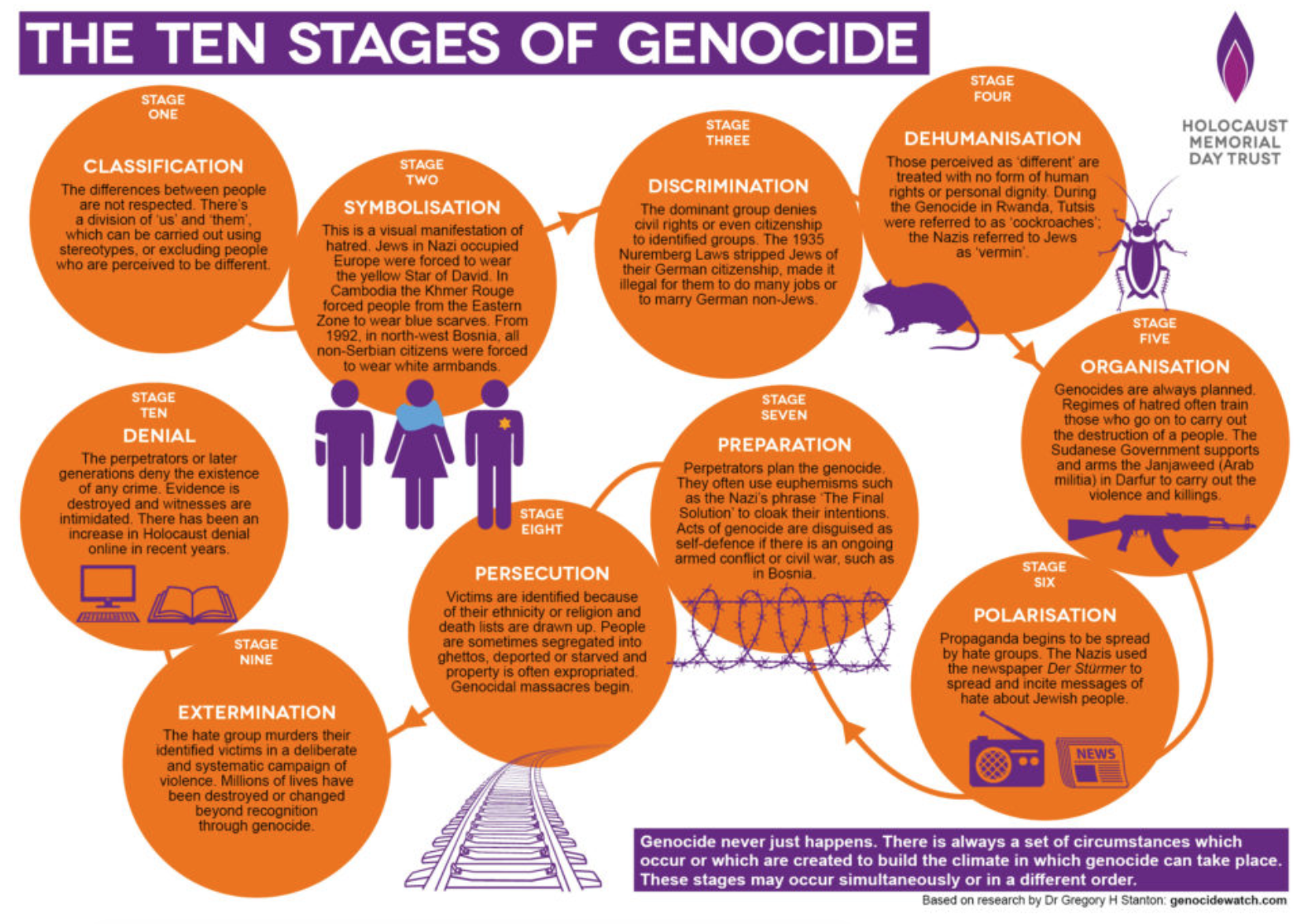
Genocide happens when people accept elements of racist ideologies slowly over time. Gregory Stanton, president of Genocide Watch created the ten steps of genocide to show how they occur and to try to suggest how to prevent them.
The ten stages of genocide create the conditions under which people can be convinced to adopt an ideology that makes them capable of allowing the murder of their own neighbours and innocent members of society. Watch the following video to understand how these ten stages contributed to the Holocaust and other genocides around the world.
The Holocaust followed these same stages of genocide. The Nazi leaders used existing feelings of resentment of Jewish people that stemmed from stereotypes developed since the middle ages. Hitler saw that by turning people in Germany against Jewish citizens, he could create more unity among those who were his followers. Jewish people were wrongly blamed for many of the economic problems of Germany after the First World War. Nazis also used a pseudo-science called social Darwinism to support their racist beliefs. This ideology held that some humans were better than others and that society could be made better by encouraging the survival of those who were considered better and elimination of those who were outcast. This thinking excluded children from school, workers from their jobs and divided families against each other.
Nazi leaders believed in eugenics. This was the idea that by stopping some people from having children, society could be made better. Jewish people were restricted from having children and often forcibly sterilized, however, eugenics policies applied to other people as well including those with disabilities or mental illness.
The same pseudoscience that was used to justify the Holocaust has been present at different times in Canadian history as well. Ideologies that seek to limit or eliminate certain individuals from society are not only found in dictatorships or countries with governments that reject liberalism. In the early 20th century, British Columbia and Alberta passed laws allowing for the sterilization of people with "undesirable genetic traits". These laws were based on social-Darwinist ideology in England which claimed that by methods such as sexual sterilization, marriage prohibition and segregation, certain "negative" traits could be removed from human populations.
The "traits" in question were not simply diseases or medical issues. Poverty, alcoholism, mental illness, intellectual disability, criminal behaviour and prostitution were all considered hereditary under this ideology and individuals were sterilized or not allowed to have children when connected to any of these issues. Many Canadian socialists, feminists, psychiatrists and others believed in eugenics. Support for the movement even came from well know activists such as Emily Murphy and Nellie McClung who worked hard to win the vote for women and many other rights.
Alberta passed laws known as the Sxexual Sterilization Acts in the 1920's and amended them until the 1970's when they were repealed. William Aberhart's government passed the first laws and Peter Lougheed's government repealed them in 1971. The laws stated things like this:
The Roman Catholic Church loudly protested these laws in Alberta and British Columbia. While other provinces did not pass laws, they did draft them and in Nova Scotia, for example, women considered unfit for motherhood were put in institutions for mental illness.
Eugenics policies were especially destructive for Indigenous people. By 1972, Indigenous and Metis women represented 25% of those sterilized under Alberta's Sexual Sterilization Acts. Most Indigenous women were forced into sterilization procedures. This occurred in residential schools and also through public medical care. Indigenous women were often coerced into having procedures (convinced through force or bribery) by being promised money or other rewards. Hundreds of sterilizations were also performed on Indigenous women without their knowledge or consent in the belief that these procedures would eliminate poverty and other social issues from communities. There is increasing evidence that forced sterilization of Indigenous women has continued into the 21st century with reports as recently as 2018. Coerced sterilization is connected to other ways that colonialism has hurt Indigenous people and targeted their culture and way of life. Prime Minister Justin Trudeau called the practices aimed at the destruction of Indigenous people and ways of life "Cultural Genocide".
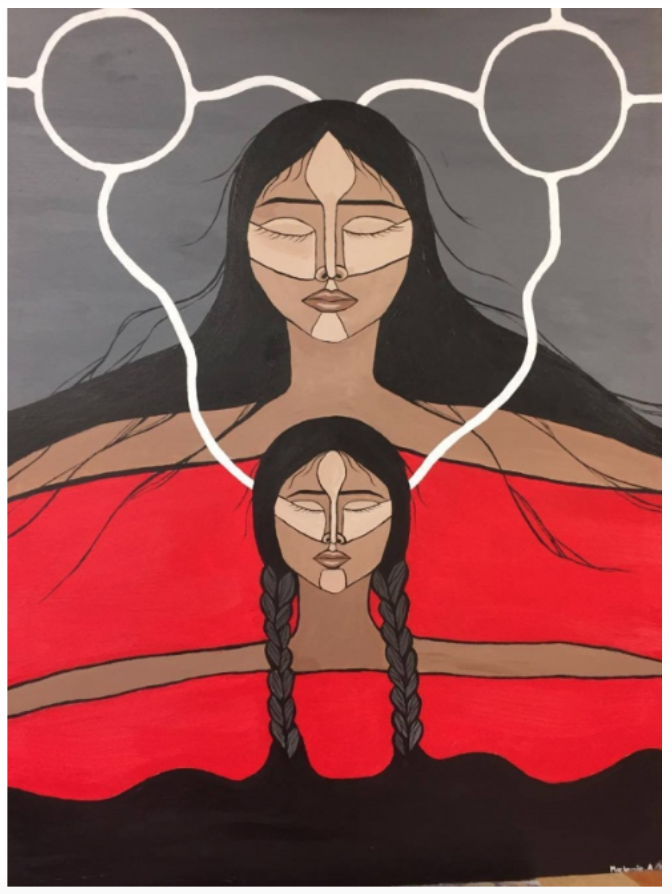
This piece "Nikawiy Nitanis" by Cree artist Mackenzie Anderson depicts the connection of mother and daughter.
Tommy Douglas — the father of socialized medicine in Canada and one of the country’s most beloved figures — at one time endorsed eugenic policies. In 1933, he received a Master of Arts in sociology from McMaster University for his thesis, The Problems of the Subnormal Family. In the thesis, Douglas recommended several eugenic policies, including the sterilization of “mental defectives and those incurably diseased.” However, by the time Douglas became premier of Saskatchewan in 1944, he had abandoned his support for sterilization. When Douglas was presented with reports that recommended legalizing sexual sterilization in the province, he rejected the idea. Instead, he adopted a different approach, including therapy for people with mental illnesses and vocational training for those with intellectual disabilities. - The Canadian Encyclopedia
Anti-semitism: hostility to or prejudice against Jewish people
Discrimination: the act of making distinctions between people based on the groups, classes, or other categories to which they belong or are perceived to belong that are disadvantageous.
Eugenics: a fringe set of beliefs and practices that aim to improve the genetic quality of a human population. Historically, eugenicists have attempted to alter human gene pools by excluding people and groups judged to be inferior or promoting those judged to be superior.
Genocide: the intentional destruction of a people in whole or in part. In 1948, the United Nations Genocide Convention defined genocide as acts committed with the intent to destroy, in whole or in part, a national, ethnical, racial or religious group.
Holocaust: also known as the Shoah, it was the genocide of European Jews during World War II. Between 1941 and 1945, Nazi Germany and its collaborators systematically murdered some six million Jews across German-occupied Europe, around two-thirds of Europe's Jewish population
Pseudoscience: consists of statements, beliefs, or practices that claim to be both scientific and factual but are incompatible with the scientific method.
Racism: discrimination and prejudice towards people based on their race or ethnicity. Racism can be present in social actions, practices, or political systems that support the expression of prejudice or aversion in discriminatory practices.
Social Darwinism: the idea that certain people become powerful in society because they are innately better. Social Darwinism has been used to justify imperialism, racism, eugenics and social inequality at various times over the past century and a half.
Visit the United States Holocaust Museum. Watch the video Path to Nazi Genocide to help you understand how the Holocaust happened in stages and how ideology contributed to it. Then explore the Virtual Museum.