During World War II, Oskar Schindler purchased a factory in Germany. He planned to produce mess kits (pots and pans and eating utensils) for the German army. Schindler hired Jews to work in his factory because they cost less to hire than other workers.
As Hitler created laws that limited the rights of minorities, especially Jews, Schindler altered the work papers for Jewish employees so that they became “essential workers” for the German war effort. These Jews were saved from the concentration camps.
After Schindler observed directly the atrocities of life and death in a camp, he changed his focus from making a profit to saving the lives of thousands of Jews. Schindler bribed German officials to reroute trains heading to concentration camps so that the trains would instead go to the factories he built in other areas of Germany.
Schindler was able to own and profit from the products made in his factory. However, Hitler and his government dictated the products Schindler’s factories would produce. The fact that Hitler determined what would be produced is a rejection of liberalism.
The life of Oscar Schindler was the inspiration for the award-winning film called Schindler's List. It is a difficult movie to watch but remarkedly well done.
In this lesson, you will examine the following question: How did a fascist economy in Nazi Germany reject liberalism?
You will learn how Hitler dealt with economic issues in Germany. His economic views brought Germany out of the Great Depression and toward economic recovery. Unlike Stalin, Hitler did not believe in economic equality or the equal distribution of resources. However, he did determine what would be produced in some factories.
By the end of World War I, Germany’s economy was in a major downturn. The war was not only responsible for the loss of millions of lives, but the war also affected the health of the economy. At the end of the war, the German government felt it had no other choice but to sign the Treaty of Versailles. By signing this treaty, Germany accepted a war-guilt clause.
Under the war-guilt clause, Germany was forced to make War Reparation Payments, which were money to pay for reconstruction in countries damaged by the war. Because Germany also suffered damage in the war, Germany had no extra money to make these payments. Germany was able to pay only a part of the country’s first payment.
During the period after World War I, Germany’s economic downturn was leading the country toward a depression. In an attempt to repair the economy, Germany printed large amounts of paper money. The more money the German government printed, the higher the prices for goods and services became.
Salaries increased too, but not as much as the prices for goods and services rose. The result was hyperinflation. Hyperinflation occurs when the prices of goods and services increase dramatically.
From 1918 to 1923, it is estimated that the German Deutschmark (the German dollar) increased by a factor of 20 billion. Within a few years, the value of the Deutschmark dropped to almost nothing. It was often cheaper to start a fire using money than it was to use the money to buy wood for the fire. Because of the high price of products, millions of Germans were facing starvation.
View the video below, “Hyperinflation in Germany”, for a better understanding of the inflation and hyperinflation that occurred in Germany after World War I.
In 1924, Germany’s economic situation improved. The Americans agreed to assist Germany with its War Reparation Payments. Germany also created a new currency (money), and foreign investors began to see Germany as a good place to invest. As more businesses opened, Germans found jobs, built houses, and began to spend and save again. Germany was on its way to economic recovery.
When Hitler took power in 1933, he had a vision of economic change.
Hitler’s economic vision came into effect because Germany, like many other European countries, was affected by the Great Depression of the 1930s. Unemployment levels were high, and morale was low. Germans feared a return to the difficulties experienced in 1918 after the end of World War I. Germans were ready to accept any change that could ease the economic difficulties they were experiencing.
Hitler introduced economic policies that would increase employment. Hitler created many public works programs similar to the ones introduced in the United States and Canada. Schools and hospitals were built; new forests were planted; and the Autobahn, a major highway to go through Germany, was built.
The Autobahn itself created thousands of jobs. However, women and Jews were banned from working. Women were told to stay home to have new babies who would become good German citizens.
Most of Germany’s jobs were created when Hitler started compulsory military service. By 1939, there were 1 400 000 men registered in the military. As soldiers in the German army, they received a small salary, shelter, and food. This was much better than being unemployed, homeless, and starving.
Hitler abolished trade unions because they were seen as being too communist in their approach. Hitler created the German Labour Front to replace labour unions. The German Labour Front did introduce some positive changes. For example, employers could no longer fire workers on the spot. However, Germans lost the right to ask for raises, and there was no longer a limit placed on the number of hours a worker could work in a week. By 1939, workers worked 60 to 72 hours a week.
Some incentives were given to motivate workers to work harder and longer hours. Cheap holidays were offered, including trips on cruise ships and ski weekends. Hitler believed that a happy worker would work harder and longer than an unhappy worker. The only problem with this plan was that these benefits were offered only to loyal members of the Nazi Party. The average worker never experienced these perks.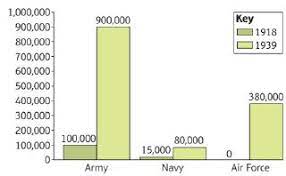
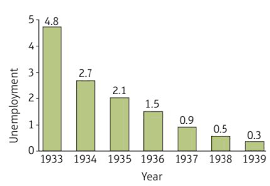
As World War II approached, Hitler continued the massive buildup of weapons in Germany. Weapons production was the backbone of the German economy. There were enough jobs for everyone and salaries were at an acceptable level. Look at the unemployment statistics in Germany between the years 1933 and 1939.
Hitler did not nationalize industries, but he often ordered businesses to produce what he thought was necessary for the creation and improvement of the German empire. A factory that once produced pots and pans could easily be transformed into a bullet factory. Hitler also put a freeze on the price of products to try and control hyperinflation.
Although Hitler would determine what would be produced and how much the producer would be paid for the product, the business remained in the hands of the private entrepreneur. The main focus of industrial activity became producing goods for the military, instead of producing goods for consumers.
Nazi efforts to rebuild the economy of Germany also included a plan to invade and take over territory in neighboring countries. To do this Hitler broke the Treaty of Versailles yet again and began to build up the German military. This led directly to World War II. In 1938 Hitler merged Germany with Austria. Then he annexed Czechoslovakia. In the fall of 1939, Germany invaded Poland and other European nations declared war on Germany. Though Germany had built a strong economy and a large military, they remained isolated in trade and were quickly cut off from resources. To continue his expansion, Hitler invaded the Soviet Union.
Authoritarian systems are militaristic. Though they may make claims of supporting the common good, they are largely concerned with supporting the interests of the leaders alone. Nazi Germany was no different and they used the excuse of the war to further take over industries and put the profits into the military, not social services.
Nazi policy was to blame Jews for all the economic problems Germany was facing. This led to a drastic rise in anti-semitism. These feelings encouraged Germans to ban Jewish people from owning businesses or working in certain industries. In 1935, the Nazis passed the Nuremberg Laws officially forbidding anyone from doing business with Jews among other racist rules. Jews were taken to concentration camps and Nazi propaganda stated that they were being used as a labour force. But the reality was that Jews were used as slave labour until they died or were murdered outright.
Annex: to declare territory belongs to another country
Anti-semitism: racism toward Jewish people
German Labour Front: a German organization that replaced unions and made new labour laws that went against liberal values
Hyperinflation: extreme inflation in which the price of a product increases at an alarming rate
Nationalization: complete government control of industries
Nuremberg Laws: the legalization of persecution of Jewish citizens
In this lesson, you explored the following question: How did a fascist economy in Nazi Germany reject liberalism?
When Hitler came to power, inflation was out of control in Germany. Hitler told factories what to produce and placed a freeze on the price of all products. This meant that supply and demand no longer determined the prices of products in Germany.
Hitler is not usually recognized for creating new economic systems, but he did transform a crushed economy into an empire in which unemployment was virtually nonexistent.
This transformation was not done in the best interest of consumers, and individuals were not always free to make their own economic decisions. Citizens were paid a fair salary for their work; but, in many instances, entrepreneurs lost the ability to determine what would be produced.
Hitler placed restrictions on what would be produced to produce more of what he wanted. He did not believe that using essential resources for consumer goods was beneficial to Germany. Why use resources to make toasters when Hitler wanted to build up the country’s military might?
You may want to access the following additional resources.
The Nuremberg Laws: “Legalizing” Persecution of Jews (video)